
Maritime English vocabulary: nautical terms by topic, with official definitions
Maritime English vocabulary is the working vocabulary of ships: directions, the ship's condition, collision rules, mooring, cargo, safety and units. STCW asks officers in charge of a navigational watch (on ships of 500 gross tonnage or more) for "adequate knowledge of the English language", including the ability to use the IMO Standard Marine Communication Phrases (SMCP). But SMCP itself says it "is not intended to provide a comprehensive maritime English syllabus" — the rest of the vocabulary you build yourself.
This guide groups key nautical terms by topic. Where an official definition exists — in the SMCP Glossary, the COLREGs, SOLAS or the Load Lines Convention — we quote it. Where there is none, we say so and give our own plain-English explanation. Example sentences come from PeakTalk's maritime courses. For radio phrases, wheel orders and message markers, see our SMCP guide.
Directions and parts of the ship
Some of the most common words at sea — bow, stern, port, starboard, aft — are used throughout SMCP and the COLREGs but are not defined in the SMCP Glossary or the COLREGs. Our plain-English explanations:
| Word | Meaning (our explanation) |
|---|---|
| bow / stern | the front / the back of the ship |
| port / starboard | the left / the right side when you face the bow |
| forward / aft | towards the bow / towards the stern |
| abeam | in a direction at right angles to the ship's length, out from her side |
| bridge | the place from which the ship is navigated |
The SMCP Glossary does define directions: cardinal points are "north, east, south and west", and half cardinal points are north east, south east, south west and north west. For bearings relative to your ship, SMCP says they are most often given "in relation to the port or starboard bow", for example: "Buoy 030 degrees on your port bow."
Three words that learners often mix up (SMCP Glossary):
- Heading: "The horizontal direction of the vessel's bows at a given moment measured in degrees clockwise from north".
- Course: "The intended direction of movement of a vessel through the water".
- Course made good: the course "over ground, after allowing for the effect of currents, tidal streams, and leeway caused by wind and sea".
From the courses: "Maintain the heading until the officer orders a course change."
The ship's condition: draught, freeboard, list, trim
- Draught (or draft): "Depth in water at which a vessel floats" (SMCP). Both spellings are correct.
- Air draft: "The height from the waterline to the highest point of the vessel" (SMCP) — important under bridges.
- Freeboard: under the Load Lines Convention (Annex I, Reg. 3(8)), the freeboard assigned is "the distance measured vertically downwards amidships from the upper edge of the deck line to the upper edge of the related load line". In simple words: how much of the hull is above the water when the ship is loaded to her load line.
- List: "inclination of the vessel to port side or starboard side" (SMCP).
- Trim: not in the Glossary. Our explanation: the difference between the draught forward and aft. SMCP phrases use it: "The vessel is on even keel", "The vessel is ... metres down by the head / stern".
From the courses:
- "After the ballast operation, report the vessel's draught to port control."
- "The ship has a slight list to port, so the officer of the watch asked for a stability check."
- "After ballasting, check the ship's freeboard because it may change."
Navigation and the collision rules
The COLREGs (International Regulations for Preventing Collisions at Sea, 1972) give exact meanings in Rule 3. The ones you will hear most:
- Underway: a vessel "is not at anchor, or made fast to the shore, or aground" (3(i)). A ship drifting with stopped engines is still underway.
- Vessel not under command: a vessel that "through some exceptional circumstance is unable to manoeuvre as required by these Rules and is therefore unable to keep out of the way of another vessel" (3(f)).
- Vessel restricted in her ability to manoeuvre: restricted "from the nature of her work", for example laying a cable or pipeline, dredging or a difficult tow (3(g)).
- Vessel constrained by her draught: a power-driven vessel severely restricted by her draught "in her ability to deviate from the course she is following" (3(h)).
- Restricted visibility: visibility restricted "by fog, mist, falling snow, heavy rainstorms, sandstorms or any other similar causes" (3(l)).
Two duties for every vessel: a proper look-out "by sight and hearing as well as by all available means" (Rule 5), and a safe speed (Rule 6). From the courses: "In restricted visibility, we posted an extra lookout and reduced speed."
Give way and stand on. These words are in the titles of Rules 16 and 17 and in the SMCP Glossary: to give way is "to keep out of the way of another vessel"; to stand on is "to maintain course and speed". Who gives way depends on the situation:
| Situation (COLREGs) | What the rule says |
|---|---|
| Overtaking, Rule 13 | any vessel overtaking keeps out of the way; you are overtaking when coming up "more than 22.5 degrees abaft her beam" |
| Head-on, Rule 14 | two power-driven vessels each "alter her course to starboard" |
| Crossing, Rule 15 | of two power-driven vessels, the one "which has the other on her own starboard side shall keep out of the way" |
The stand-on vessel keeps her course and speed, but may act to avoid collision if the give-way vessel is not acting (Rule 17). From the courses: "In the crossing situation, as the stand-on vessel, we kept our course and speed but were ready to manoeuvre if needed."
Sound signals. A short blast is "about one second's duration"; a prolonged blast is "from four to six seconds' duration" (Rule 32). When vessels are in sight of one another, a power-driven vessel underway that is manoeuvring as these Rules allow or require uses one short blast for "I am altering my course to starboard", two short blasts for "I am altering my course to port" and three for "I am operating astern propulsion" (Rule 34(a)).
Mooring and anchoring
The SMCP berthing phrases give you the names of the lines: head line, stern line, breast line and springs (forward and aft). Useful orders from SMCP (shortened):
- "Send out the head / stern / breast lines."
- "Pick up the slack on the ... line(s) / ... spring(s)."
- "Slack away / check the ... line(s) / ... spring(s)."
- "Make fast fore and aft."
- "Single up the ... lines and ... springs fore and aft." (before unberthing)
Let go means "to set free, let loose, or cast off (of anchors, lines, etc.)" and moor means to secure a vessel with lines or anchors (SMCP Glossary).
From the courses:
- "We tightened the breast line to keep the ship alongside the berth in the strong tide."
- "Make sure the fender is correctly positioned to prevent damage to the ship's side while alongside."
- "Stand by the anchor and be ready to let go when the bridge gives the order."
Cargo words
From the SMCP Glossary:
- Shifting cargo: "Transverse movement of cargo, especially bulk cargo, caused by rolling or a heavy list".
- Segregation (of goods): "Separation of goods which for different reasons must not be stowed together".
- SWL: "Safe working load: maximum working load of lifting equipment that should not be exceeded".
- TEU: "Twenty Foot Equivalent Unit (standard container dimension)".
From the courses:
- "Before departure, check the cargo lashing to make sure the containers are secure."
- "Place dunnage between the steel coils to prevent metal-to-metal contact during the voyage."
- "Check that the cargo manifest matches the cargo on board, and report any discrepancy immediately."
Safety and emergency
- General emergency alarm: "A sound signal of seven short blasts and one prolonged blast given with the vessel's sound system" (SMCP).
- Assembly station: the place "where they have to meet according to the muster list when the corresponding alarm is released or announcement made" (SMCP). SOLAS Chapter III uses muster station for a similar idea, without a formal definition in III/3.
- Survival craft: "a craft capable of sustaining the lives of persons in distress from the time of abandoning the ship" (SOLAS III/3.23).
- Rescue boat: "a boat designed to rescue persons in distress and to marshal survival craft" (SOLAS III/3.19).
- Abandon vessel: "To evacuate crew and passengers from a vessel following a distress" (SMCP).
SMCP phrases for a person in the water: "Man overboard on starboard side!", "Drop lifebuoy(s).", "Hoist flag signal Oscar."
From the courses: "When the alarm sounds, muster at your assigned muster station wearing your lifejacket."
Units at sea
- Nautical mile: 1 nautical mile = 1852 m (BIPM SI Brochure).
- Knot: 1 nautical mile per hour. The BIPM notes: "There is no internationally agreed unit symbol for either unit."
- Fathom: "A measure of 6 feet" (SMCP).
- Cable (as a measurement): "one hundred fathoms or one tenth of a nautical mile" (SMCP). The two values are close but not equal, so check which value your company or the publication you use applies.
Words with two meanings
Many sea words also have an everyday meaning — and our courses use both:
- knot — a speed (one nautical mile per hour) and a knot in a rope: "Before you heave on the line, check that the knot is secure and will hold under load."
- draft — the depth of the ship in the water, and (as a verb) to write a first version of a document: "I will draft an email to the terminal operator about the delay."
- forward — towards the bow, and to send on an email: "Please forward the terminal's email to the chief officer for review."
- cable — the SMCP Glossary gives three meanings: the anchor chain, a wire or rope for mooring, and a measurement.
- berth — SMCP gives two: "a sea room to be kept for safety around a vessel" and "the place assigned to a vessel" at anchor or alongside.
If a word could be understood in two ways, add context: "anchor cable", "speed ten knots", "forward mooring station".
Try it: 5 quick questions
- A ship has stopped its engines and is drifting. It is not at anchor, not made fast to the shore and not aground. Under COLREG Rule 3, it is:
- a) underway
- b) not underway
- c) at anchor
- Which is "the horizontal direction of the vessel's bows at a given moment"?
- a) course
- b) heading
- c) track
- In a crossing situation between two power-driven vessels, which one keeps out of the way?
- a) the one with the other on her own port side
- b) the larger one
- c) the one with the other on her own starboard side
- The general emergency alarm in the SMCP is:
- a) three short blasts
- b) seven short blasts and one prolonged blast
- c) one prolonged blast
- How long is one nautical mile?
- a) 1852 m
- b) 1609 m
- c) 1000 m
Answers: 1 a · 2 b · 3 c · 4 b · 5 a
How to learn these words
- Learn words in pairs and groups, not alone: bow/stern, port/starboard, heading/course, draught/air draft.
- Say each COLREG situation out loud in one sentence: "We are overtaking, so we keep out of the way."
- For every word with two meanings, write one sentence for each meaning.
- Read the SMCP Glossary once: it is short, and it shows the official definitions.
For an overview of the rules and tests, see our guide to Maritime English.
Practise maritime English in PeakTalk
Sources
- IMO — Standard Marine Communication Phrases, resolution A.918(22), with Glossary
- USCG — Navigation Rules, International (COLREGs text)
- Canada — Collision Regulations, Schedule 1 (COLREGs text)
- International Convention on Load Lines, 1966 (UN Treaty Series No. 9159)
- IMO — SOLAS, Consolidated Edition 2020
- IMO — STCW Convention and Code, 2011 edition
- BIPM — The International System of Units (SI Brochure), 9th edition
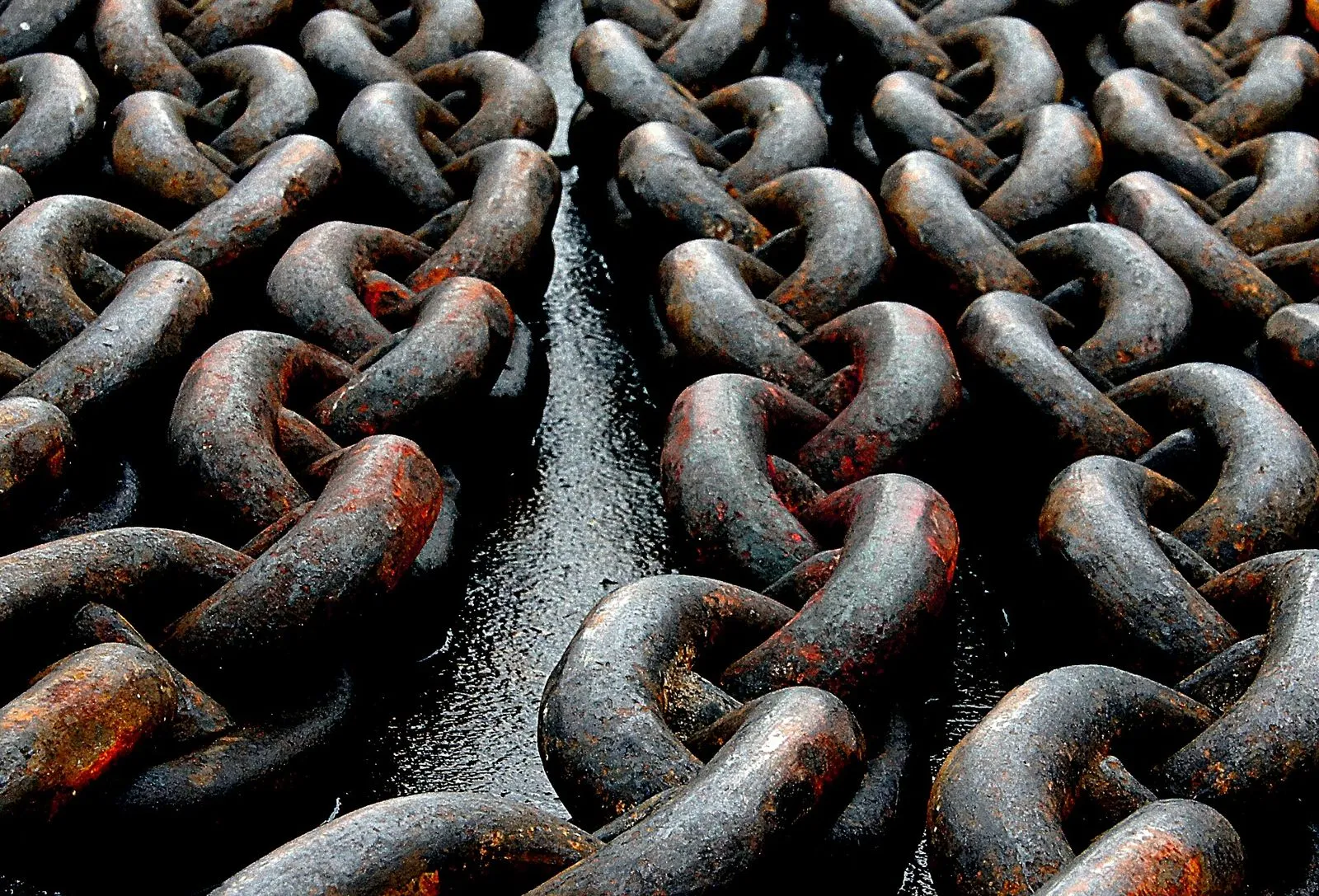
Definitions in this guide are quoted from the sources above: IMO SMCP (resolution A.918(22)) and its Glossary, the COLREGs (text as published by the US Coast Guard and in Canada's Collision Regulations; spelling of Rule 3(f) follows the Canadian text, the wording of 3(h) the US text), the Load Lines Convention 1966, SOLAS (2020 consolidated edition), STCW and the BIPM SI Brochure. Where no official definition exists, the explanation is ours. Last checked on 27 November 2026. PeakTalk is not affiliated with the IMO, the US Coast Guard, Transport Canada or the BIPM. Cover photo: “Anchor chain (cable)” by Bernard Spragg, CC0, via Wikimedia Commons.

Frequently asked questions
- What is maritime English vocabulary?
- It is the working vocabulary of ships: directions and parts of the ship, navigation and collision rules, mooring, cargo, safety and units. Many terms have official definitions in IMO documents such as the SMCP Glossary, the COLREGs and SOLAS. Everyday words like bow, stern, port and starboard are used in these rules but not defined in them.
- What is the difference between heading and course?
- In the IMO SMCP Glossary, heading is the direction of the vessel's bows at a given moment, measured clockwise from north. Course is the intended direction of movement through the water. Course made good is the course over the ground, after allowing for the effect of currents, tidal streams and leeway.
- What does underway mean?
- Under COLREG Rule 3(i), a vessel is underway when it is not at anchor, or made fast to the shore, or aground. So a ship that has stopped its engines but is not at anchor, not made fast to the shore and not aground is still underway.
- How long is a nautical mile?
- 1 nautical mile = 1852 m, and 1 knot = 1 nautical mile per hour (BIPM SI Brochure). The BIPM notes that there is no internationally agreed symbol for either unit.
- Is a muster station the same as an assembly station?
- They are used for a similar idea. The SMCP Glossary defines an assembly station as the place where crew and passengers meet according to the muster list when the alarm sounds. SOLAS Chapter III uses the term muster station but does not define it in Regulation 3.