
Marine engineer interview questions: short answers in simple English
A marine engineer interview usually has three parts: questions about you, questions about safety and technical questions. For international companies it is often in English. This guide gives you common questions for engine cadets, 4th, 3rd and 2nd engineers, short sample answers in simple English, and the rules behind the technical answers — so you answer correctly, not from an old forum post.
Part 1: personal questions
Short answers work best: two or three sentences, then stop and let the interviewer ask more. Change the samples to your own story.
1. "Tell me about yourself."
Cadet: "My name is Ali. I study marine engineering, and I have finished my STCW basic safety training. I want to start as an engine cadet and become an engineer officer."
Experienced: "Briefly, I am a junior engineer with three completed contracts, the last two on tankers. I am experienced in using purifiers, and now I want to move up to third engineer."
2. "Why did you choose marine engineering?"
"I like machines and practical problem solving. My ambition is to become a chief engineer in the future."
3. "Why did you leave your last ship?" They check: is there a problem behind your answer? Be honest and short.
"I completed my contract and returned home as planned."
4. "Who do you report to during a normal watch?"
"On my last ship, I reported to the second engineer. Anything unusual I also reported to the chief engineer, as our standing orders said."
5. "What do you do if a job looks unsafe?" They check: your real safety attitude. This answer matters a lot.
"I stop and ask before I continue. I would refuse unsafe work and explain my reason in a calm way."
6. "What do you do if you disagree with a senior engineer?" STCW itself expects engineers to speak up: one of its criteria for engine-room resource management is that "questionable decisions and/or actions result in appropriate challenge and response".
"I explain my concern politely and give the facts, for example a reading I don't trust. If it is about safety, I don't keep quiet."
7. "Can you work with equipment you don't know?"
"I learn quickly on new equipment, but I need a proper handover first."
Part 2: technical questions
Here are questions that come up often, with short answers and where the answer comes from.
What is the difference between a two-stroke and a four-stroke engine? Both have the same events: intake, compression, power and exhaust. In a four-stroke engine, one cycle takes "two rotations of the crankshaft, or 720°". In a two-stroke engine, the same events happen "in only one rotation of the crankshaft, or 360°". In a diesel engine, fuel is sprayed into hot compressed air and ignites without a spark.
Why must a centrifugal pump be primed? Most centrifugal pumps are not self-priming: the casing must be full of liquid before you start the pump. If it fills with gas, the impeller spins in a gas bubble and cannot move the liquid. This is called gas binding.
Why does a positive displacement pump need a relief valve? A positive displacement pump delivers a fixed volume each cycle, whatever the pressure. If the discharge valve is shut or a strainer is blocked, the pressure rises and can damage the pump or the piping. The relief valve, fitted before the discharge valve, protects the pump and the piping. And a centrifugal pump? It should not run for long with no flow either: the liquid heats up, can turn to vapour and damage the pump.
What is the difference between a purifier and a clarifier? Both are centrifugal separators. A purifier separates water and sludge from the oil, and the water is discharged all the time. In the classic design it needs a gravity disc of the right size for the oil, to keep the oil–water interface in the right place. A clarifier separates sludge and can handle only a small amount of water: its water outlet is blocked, and a clarifier disc is fitted instead of a gravity disc. Always check the manual for your separator model.
What is the 15 ppm rule? What is the Oil Record Book? Under MARPOL Annex I, outside special areas, a ship of 400 GT and above may discharge oily water from the machinery space only when all the conditions are met. The main ones:
- the ship is "proceeding en route";
- the mixture goes through approved oil filtering equipment;
- its oil content "does not exceed 15 parts per million".
On ships of 10,000 GT and above, the system must have an alarm and must stop the discharge automatically above 15 ppm. Special areas have stricter conditions.
Operations such as bunkering, sludge disposal and bilge water discharge are recorded "without delay" in the Oil Record Book Part I (Machinery Space Operations). The officer in charge signs each operation, and the master signs each page. The book stays on board for three years after the last entry.
What do you check before entering an enclosed space? In June 2025 the IMO adopted revised recommendations (resolution MSC.581(110)). Key points:
- Nobody should enter without authorization from the master or a responsible person nominated by the master (for example the chief engineer or second engineer).
- When the risk assessment shows any risk, use an entry permit. Its validity depends on the risk assessment and is never longer than eight hours.
- The space is ventilated, then tested with calibrated instruments. Testing is done with the ventilation stopped, after conditions are steady.
- Steady readings the IMO recommends: 20.9% oxygen, carbon dioxide below 0.5%, less than 50% of the exposure limit of any toxic gas and, where flammable gases are possible, less than 1% of the lower flammable limit. National requirements may differ, so follow your company's procedure.
- People entering wear personal gas detectors. An attendant keeps watch over the people inside, and rescue equipment is ready at the entrance.
- In an emergency, the attendant must not go in before help arrives. Only trained and equipped rescuers go in.
Careful: older guides quote "21% oxygen" from the previous version, resolution A.1050(27).
What is a permit to work? What is lock-out/tag-out? A permit to work is a written safety procedure for dangerous jobs, such as enclosed space entry, hot work, work on isolated machinery or electrical work. Your ship's safety management system says when you need one. As the UK Code of Safe Working Practices puts it, a permit "does not in itself make the job safe but ensures that you follow measures for safe working". Lock-out/tag-out means the energy source is isolated, locked, and tagged with the name of the person who placed the lock, so nobody can start the machine during the work.
What is the fire triangle? What are the fire classes? STCW lists the three elements of fire as fuel, a source of ignition and oxygen. Remove one and the fire goes out. Fire classes are a trap, because the US and Europe use different letters:
| Fire | Europe (EN 2) | USA (OSHA) |
|---|---|---|
| Solid materials: wood, paper, cloth | A | A |
| Flammable liquids | B | B |
| Flammable gases | C | B |
| Live electrical equipment | treated separately, not one of the lettered classes above | C |
| Metals | D | D |
| Cooking oils and fats | F | K (in the NFPA 10 standard, not in OSHA's list) |
These are shore standards. In the interview, say which system you mean, and check which one your ship and company use.
Part 3: what changes with your rank
Interviewers adjust the questions to the job. This is our summary of common topics, not a fixed rule:
| Rank | Typical focus |
|---|---|
| Engine cadet | motivation, basic engine and pump principles, safety attitude, your training record book |
| 4th / 3rd engineer | watchkeeping and handover, pumps, separators, the oily water separator and Oil Record Book, enclosed space entry |
| 2nd engineer | maintenance planning, permits and isolations, leading the engine team; under the IMO enclosed space recommendations, the second engineer can be the responsible person who authorizes entry |
Practise the watch handover. Many interviewers ask "What do you check when you take over the watch?" Answer in clear handover English, for example:
- "For the port watch handover, the cooling water temperature is within limits."
- "Anything to report from the watch? — Nothing abnormal in the engine room."
- "Which jobs are still pending? — The pump check and the purifier cleaning."
Talk a fault through. Show that you think before you act:
- "Do not trust a faulty reading until you check another instrument."
- "Can we rule out a sensor fault? — Yes, the local gauge shows the same pressure."
- "Can I open the pump cover? — Not yet; isolate the pump, apply locks and tags, and check there is no pressure."
These sentences are from PeakTalk's Engine Room Communication course.
Part 4: what to say when you don't understand
On a video call, with a new accent, you may miss a word. Asking is normal: in the engine room, checking information is a safety habit. Phrases from PeakTalk's Crewing Interview Prep course:
- "I missed the first word of your question."
- "Could you clarify what you mean by tanker experience?"
- "Can I check one point before I answer the safety question?"
If you don't know the answer, say what you know and be honest about the rest: "I am not sure about the exact limit, but I know we test the atmosphere and need a permit before entry." A guess that turns out wrong is worse than an honest "I am not sure".
Try it: 5 quick questions
- How many crankshaft turns does one cycle of a four-stroke engine take?
- a) one
- b) two
- c) four
- Which machine has its water outlet blocked?
- a) a clarifier
- b) a purifier
- Under MARPOL Annex I, what is the oil content limit for discharging oily water through the filtering equipment?
- a) 5 ppm
- b) 50 ppm
- c) 15 ppm
- In Europe (EN 2), a fire of flammable gas is class:
- a) B
- b) C
- c) F
- Your friend is unconscious inside a tank. You are the attendant. What do you do first?
- a) Go in and pull him out.
- b) Raise the alarm and call for help; do not enter before help arrives.
- c) Start the ventilation and wait.
Answers: 1 b · 2 a · 3 c · 4 b · 5 b
A 2-week preparation plan
Days 1–3: your story. Write short answers to the personal questions above. Say them out loud and record yourself.
Days 4–9: technical basics. Engines, pumps, separators, MARPOL and the oily water separator, enclosed spaces, fire fighting. For each topic, practise a three-sentence explanation in simple English.
Days 10–12: handover and fault English. Describe a watch handover and a real fault from your experience, step by step.
Days 13–14: a mock interview. Ask a friend to interview you on a video call and to add one question you did not prepare.
Practise engine room English in PeakTalk
Sources
- US DOE — Fundamentals Handbook, Mechanical Science, vol. 1 (engines and pumps)
- Alfa Laval — MOPX separation systems (purifier and clarifier)
- IMO — MARPOL Annex I, resolution MEPC.117(52)
- IMO — Revised recommendations for entering enclosed spaces aboard ships, MSC.581(110)
- UK MCA — Code of Safe Working Practices for Merchant Seafarers, 2024 edition
- OSHA — 29 CFR 1910.155 (US fire classes)
- North Wales Fire and Rescue Service — fire classes (BS EN 2)
- IMO — STCW Convention and Code, 2011 edition
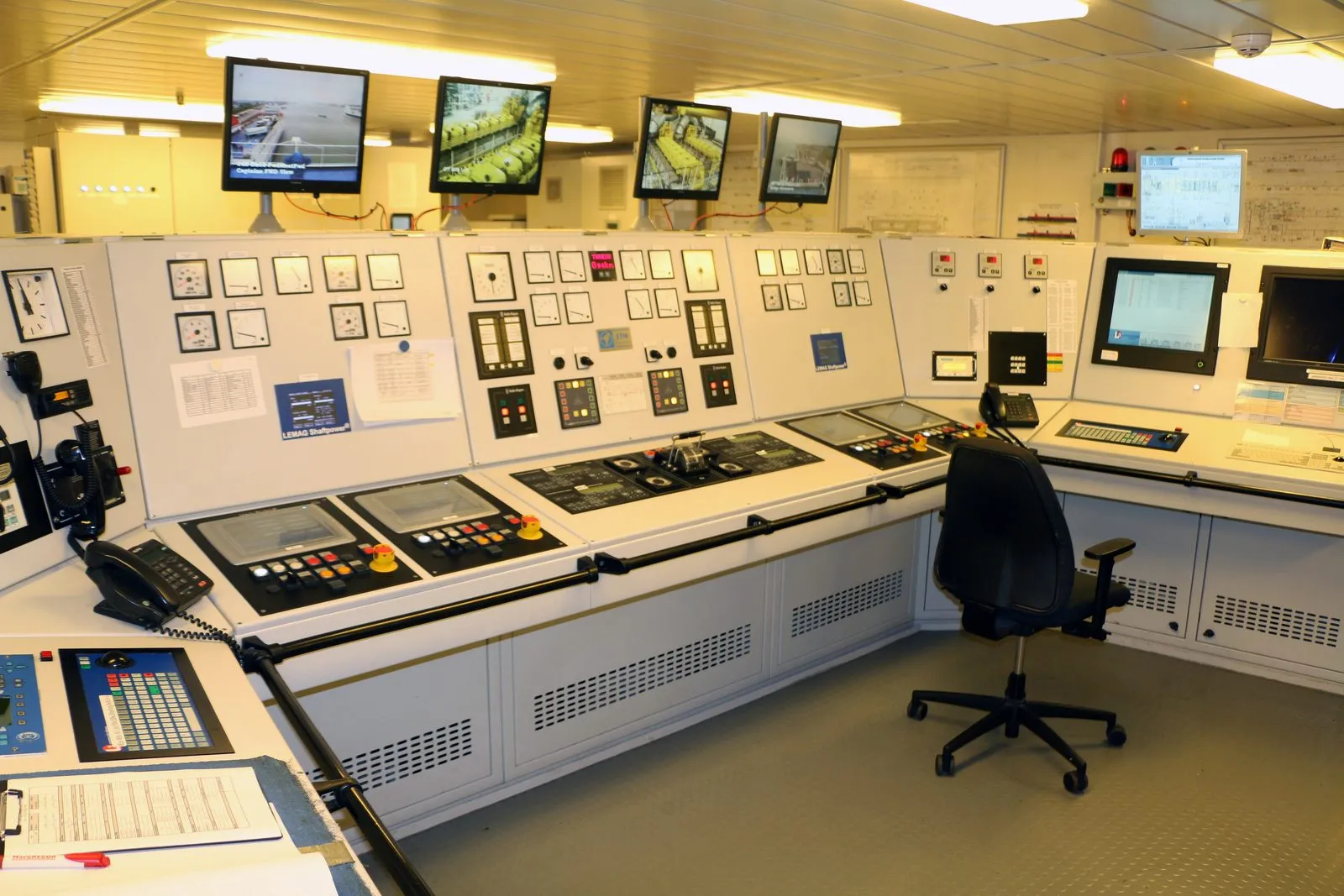
Technical answers in this guide are based on the sources above: US DOE handbook, Alfa Laval, MARPOL Annex I (the linked text is the 2004 revised Annex I; check the current consolidated edition for exact wording), IMO resolution MSC.581(110), the UK Code of Safe Working Practices (2024 edition), OSHA, the North Wales Fire and Rescue Service and STCW. Last checked on 25 November 2026. Follow your ship's procedures and manufacturer instructions; sample answers are examples, and every company interviews in its own way. Cover photo: “Stena Hollandica Engine Control Room” by Roel Hemkes, CC BY 2.0, resized, via Wikimedia Commons.

Frequently asked questions
- What questions are asked in a marine engineer interview?
- Usually three kinds: personal questions (your experience, why you left your last ship, your goals), safety questions (permits, enclosed spaces, what you do if a job is unsafe) and technical questions (engines, pumps, separators, MARPOL and the oily water separator, fire fighting).
- What is the difference between a two-stroke and a four-stroke engine?
- Both have the same four events: intake, compression, power and exhaust. A four-stroke engine needs two turns of the crankshaft (720°) for one cycle. A two-stroke engine does it in one turn (360°).
- What oxygen level is needed before entering an enclosed space?
- The IMO recommendations revised in 2025 (resolution MSC.581(110)) recommend steady readings of 20.9% oxygen by volume, carbon dioxide below 0.5%, less than 50% of the exposure limit of any toxic gas and, where flammable gases are possible, less than 1% of the lower flammable limit. Older guides quote 21% from the previous version. National rules may differ.
- What is the 15 ppm rule?
- Under MARPOL Annex I, outside special areas, a ship of 400 GT and above may discharge oily water from the machinery space only through approved oil filtering equipment, with an oil content not above 15 parts per million, while the ship is en route, plus other conditions. Special areas have stricter rules. Each operation is recorded in the Oil Record Book Part I.
- Do I need good English for a marine engineer interview?
- For an international company, usually yes. STCW asks engineer officers of the watch for adequate English to use engineering publications and perform their duties. You don't need perfect English, but you need clear, short answers and the confidence to ask when you don't understand.