
Deck cadet interview questions: sample answers in simple English
A deck cadet interview checks two things: are you the right person to live and work on a ship, and do you know the basics of watchkeeping? Interviews for international companies are often in English, and some are on a video call. You do not need perfect English. You need clear, short answers and the confidence to ask when you don't understand.
This guide gives you the questions cadets hear most often, short sample answers in simple English, and the collision rules (COLREGs), a common topic in technical questions.
Part 1: personal questions
For each question: what the interviewer wants to know, and a short sample answer. Use the samples as a model, then change them to your own story.
1. "Tell me about yourself." They check: can you speak clearly about yourself for 30 seconds?
"My name is Daniel. I am 20 and I study nautical science at a maritime academy. I have finished my STCW basic safety training. I want to start my sea career as a deck cadet and become a navigation officer."
2. "Why do you want to go to sea?" They check: is this a real decision, or just a job?
"I want a professional career with clear steps: cadet, then officer, then more responsibility. I like practical work, and I am ready for long contracts away from home."
3. "Why do you want to join our company?" They check: did you prepare? Read about the company's ships and trade before the interview.
"Your company operates [type of ships, for example tankers], and I want to learn on modern vessels. My main motivation is to build a steady career with one good company."
4. "What is your main strength?"
"My strength is that I learn routines fast and ask clear questions. For example, in my academy training I learned the ship's safety drills quickly and helped other students."
5. "What is your weakness?" They check: are you honest, and are you working on it? Choose a real weakness that is not dangerous for the job.
"Sometimes I ask too many questions before I start a task. Now I write my questions down first and ask them together."
6. "How will you cope with long months on board?"
"I know contracts are long. I will keep a routine, plan my rest, exercise, and keep in touch with my family when Wi-Fi is available. I also want to use the time to study for my next certificate."
7. "What does safety mean to you?" They check: your real attitude. This is one of the most important answers.
"Safety comes first. If I see an unsafe condition, I tell my supervisor at once. I speak up if a job looks unsafe, even if I am new to the crew."
8. "Do you agree with our drug and alcohol policy?"
"Yes. I understand the policy, I will follow it, and I support it. Alcohol and drugs have no place on board."
9. "Where do you see yourself in five years?"
"I hope to complete my cadetship, get my officer's certificate and return as a junior officer."
10. "Do you have any questions for us?" Always have one or two. For example: "What type of vessel will I join?" or "Is there career progression for cadets who get good reports?"
Part 2: technical questions (COLREGs)
Technical questions can cover navigation equipment, buoys, meteorology and seamanship, but the International Regulations for Preventing Collisions at Sea (COLREGs) come up often. Learn the meaning, and know the key words of the rule. Quotes below are from the official text.
What is a proper look-out? (Rule 5) Every vessel must "at all times maintain a proper look-out by sight and hearing as well as by all available means", for example radar, to fully understand the situation and the risk of collision. In simple words: always watch and listen, and use every tool you have.
What is safe speed? (Rule 6) A speed at which the vessel can "take proper and effective action to avoid collision and be stopped within a distance appropriate to the prevailing circumstances and conditions". There is no single number: it depends on visibility, traffic, the depth of water and the vessel itself.
How do you know there is a risk of collision? (Rule 7) Use all available means. One key sign: risk of collision is deemed to exist "if the compass bearing of an approaching vessel does not appreciably change". But a changing bearing does not always mean it is safe, especially with a very large vessel, a tow or a vessel at close range. And remember: "If there is any doubt such risk shall be deemed to exist."
When is a vessel overtaking? (Rule 13) When it comes up from "more than 22.5 degrees abaft her beam" (abaft the beam = behind the line across the middle of the ship) — at night it would see only her sternlight, not her sidelights. The overtaking vessel must keep out of the way. If in doubt, assume you are overtaking.
Two power-driven vessels meet head-on. What do they do? (Rule 14) When they meet on opposite or nearly opposite courses and there is risk of collision, each alters course to starboard, so that each passes on the port side of the other.
Two power-driven vessels are crossing. Who gives way? (Rule 15) When there is risk of collision, the vessel which has the other on her own starboard side keeps out of the way and, if possible, avoids crossing ahead of her.
What do the give-way and stand-on vessels do? (Rules 16 and 17) The give-way vessel must, so far as possible, take "early and substantial action to keep well clear". The stand-on vessel keeps her course and speed. If it becomes clear that the give-way vessel is not taking the right action, the stand-on vessel may act by her own manoeuvre (Rule 17(a)). If the give-way vessel alone can no longer avoid collision, the stand-on vessel must act to help avoid it (17(b)). In a crossing with another power-driven vessel, if she acts by herself, she must not turn to port for a vessel on her own port side, if the circumstances allow (17(c)).
Who keeps out of the way of whom? (Rule 18) A power-driven vessel underway keeps out of the way of a vessel not under command, a vessel restricted in her ability to manoeuvre, a vessel engaged in fishing and a sailing vessel. A simple way to remember the order for vessels underway, starting with the vessel that others give way to first: not under command (cannot manoeuvre, for example because of a breakdown) → restricted in her ability to manoeuvre (because of her work, for example dredging) → fishing → sailing → power-driven. Rules 9, 10 and 13 (narrow channels, traffic separation schemes and overtaking) can change this. A vessel constrained by her draft is separate: other vessels, except those not under command or restricted in their ability to manoeuvre, must avoid impeding her safe passage (18(d)).
Navigation lights (Rule 21):
| Light | Colour | Arc of the horizon |
|---|---|---|
| Masthead light | white | 225° — from right ahead to 22.5° abaft the beam on each side |
| Sidelights | green (starboard), red (port) | 112.5° each — from right ahead to 22.5° abaft the beam on its side |
| Sternlight | white | 135° — 67.5° from right aft on each side |
| All-round light | depends on its use | 360° |
Manoeuvring and warning signals (Rule 34): When vessels are in sight of one another, a power-driven vessel underway shows her manoeuvre with these whistle signals:
- one short blast — "I am altering my course to starboard"
- two short blasts — "I am altering my course to port"
- three short blasts — "I am operating astern propulsion"
- at least five short and rapid blasts (any vessel in doubt) — a warning: you do not understand the other vessel's intentions, or you doubt that it is taking enough action to avoid collision
Careful: US inland waters have their own rules, and some whistle signals there mean something different. In an interview for an international company, answer with the international rules above.
Part 3: what to say when you don't understand
Many guides skip this. On a video call, with an accent you don't know, you will sometimes miss a word. Asking is not a weakness: on a ship, checking that you understood is a safety habit. Use these phrases from PeakTalk's Crewing Interview Prep course, and adapt them to your own story:
- "I missed the first word of your question."
- "Could you rephrase the question about teamwork on board?"
- "Does your question refer to my last vessel or all my sea service?" (for a cadet: "…to my sea training or to my studies?")
- "I want to make sure I understand the question about my last contract."
- "Can I check one point before I answer the safety question?"
When you don't know the answer, say what you do know and be honest about the rest. An honest "I am not sure" is better than a false answer. For example:
"I am not sure about the exact rule number, but I know that in a crossing situation the vessel which has the other on her starboard side must give way."
Common mistakes
A memorised speech. Interviewers often notice it, and one unexpected question breaks it. Prepare key points, not full texts.
One-word answers. "Yes." "No." "Teamwork." Add one reason or one example: "For example, I helped a new cadet follow safe work steps on deck."
Mixing up starboard and port under stress. Practise the COLREG answers out loud until they come without thinking.
Try it: 5 quick questions
- Two power-driven vessels are crossing. Vessel A has vessel B on her starboard side. Who gives way?
- a) Vessel A
- b) Vessel B
- c) The bigger vessel
- You hear one short blast from a power-driven vessel in sight. What does it mean?
- a) "I am altering my course to port"
- b) "I am altering my course to starboard"
- c) "I am operating astern propulsion"
- What is the arc of a sternlight?
- a) 112.5°
- b) 225°
- c) 135°
- The compass bearing of an approaching vessel does not change. What does it mean?
- a) Risk of collision is deemed to exist.
- b) There is no risk of collision.
- c) The other vessel is anchored.
- You did not hear the interviewer's question. What is the best answer?
- a) "Yes, of course."
- b) Answer what you think the question was.
- c) "Sorry, I missed the question. Could you repeat it, please?"
Answers: 1 a · 2 b · 3 c · 4 a · 5 c
A 2-week preparation plan
Days 1–3: your story. Write short answers to the ten personal questions above, then say each one out loud. Record yourself on your phone and listen.
Days 4–8: COLREGs. Learn Rules 5–7, 13–18, 21 and 34 — the meaning and the key words. Explain each rule out loud in your own simple English.
Days 9–12: practise speaking. Ask a friend or classmate to interview you, ideally on a video call. Ask them to change the order of questions and to add one you did not prepare.
Days 13–14: the company. Read about the company's fleet and trade. Prepare two questions for them. Check your internet, camera and a quiet room if the interview is online.
Practise interview English in PeakTalk
Sources
- USCG — Navigation Rules, International and Inland (text of COLREGs 1972)
- IMO — Convention on the International Regulations for Preventing Collisions at Sea (COLREGs)
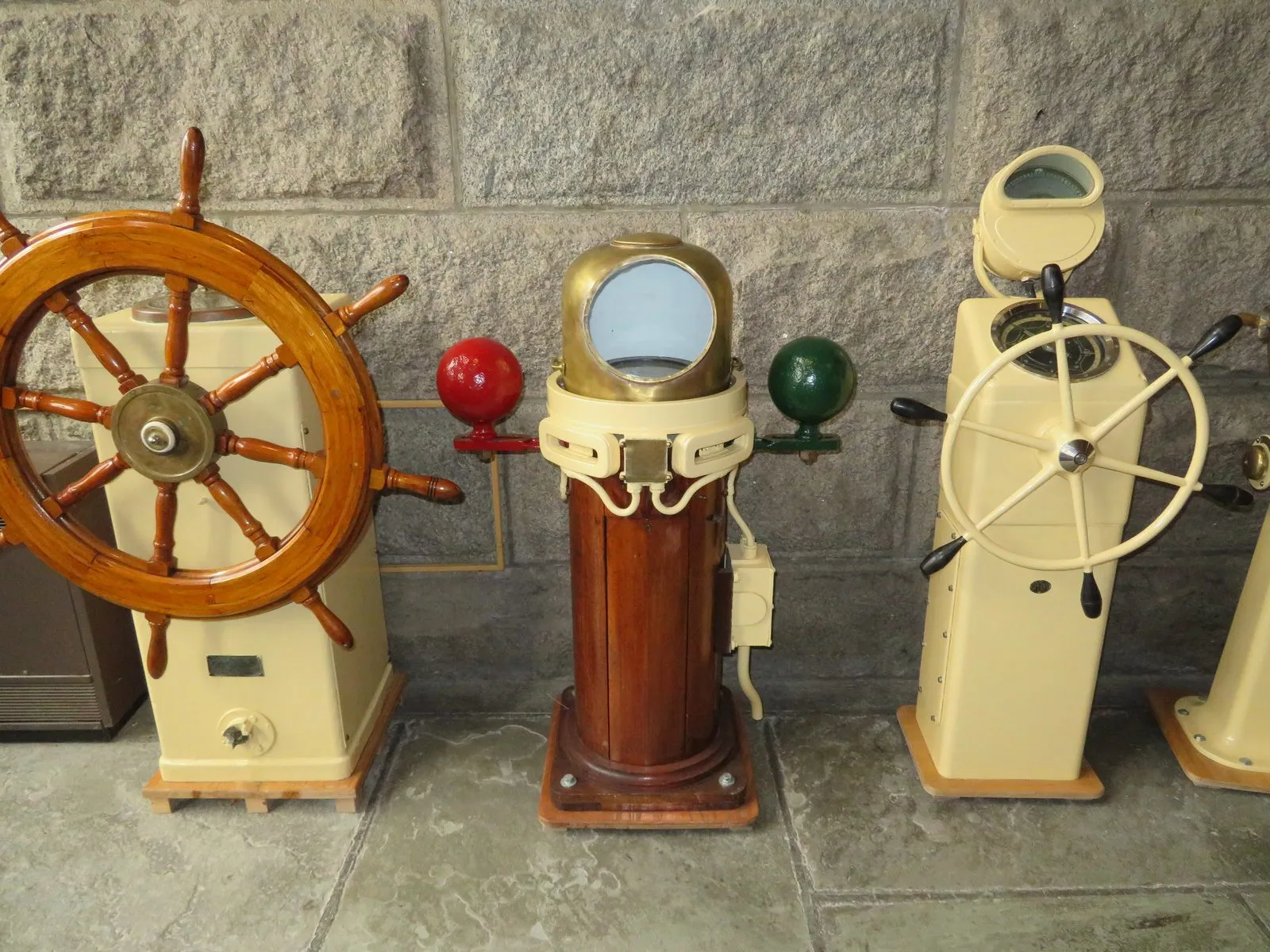
The COLREG quotes in this guide are from the text of the International Regulations for Preventing Collisions at Sea, 1972, as published in the US Coast Guard Navigation Rules as amended (links above). Last checked on 25 November 2026. Sample answers are examples; every company runs its interviews in its own way. Cover photo: Worldwidewebb77, CC BY 4.0, resized, via Wikimedia Commons.

Frequently asked questions
- What questions are asked in a deck cadet interview?
- Usually two kinds. Personal questions: tell me about yourself, why you want to go to sea, why this company, your strengths, how you will live on board, your attitude to safety. And technical questions, often about the collision regulations (COLREGs) as well as navigation equipment, buoys and seamanship. Typical COLREG topics: look-out, safe speed, overtaking, head-on and crossing situations, lights and sound signals.
- How should I answer 'Tell me about yourself'?
- Give a short answer of three or four sentences: who you are and where you studied, what training or sea time you have, and why you want this job. Prepare it, but say it in your own words, not as a memorised text.
- What if I don't understand the interviewer's question?
- Ask. Say "Sorry, could you repeat the question?" or "Could you rephrase that, please?" Asking is normal and shows that you check information — an important habit at sea. Guessing the meaning and giving a wrong answer is worse.
- What if I don't know the answer to a technical question?
- Be honest. Say what you do know, for example: "I am not sure about the exact angle, but I know the overtaking vessel must keep out of the way." Do not invent an answer.
- Which COLREG rules should a deck cadet know for the interview?
- At least Rule 5 (look-out), Rule 6 (safe speed), Rule 7 (risk of collision), Rules 13 to 17 (overtaking, head-on, crossing, give-way and stand-on vessels), Rule 18 (responsibilities between vessels), Rule 21 (definitions and arcs of lights) and Rule 34 (manoeuvring and warning signals).