
English for mechanical engineers: words and phrases for pumps, maintenance, permits and reports
A mechanical engineer on an oil, gas or process site uses English for a few clear jobs: reporting a fault, isolating equipment, working under a permit, handing over to the next shift and writing numbers in a report. This guide is for working engineers whose first language is not English. It gives you the key words, sentence patterns and common mistakes, with examples from PeakTalk's English for Mechanical Engineers course.
The technical explanations come from open primary sources: the US Department of Energy (DOE) handbooks, OSHA regulations, UK HSE guidance and NIST. Rules differ by country and company, so we say where each one comes from.
Pump words you will use every week
| Term | Plain-English meaning |
|---|---|
| cavitation | vapour bubbles form at low pressure in the pump and then collapse |
| NPSH available / required | how far the suction pressure is above the liquid's vapour pressure / the minimum the pump needs to avoid cavitation |
| gas binding | the casing is full of gas, so the impeller cannot move the liquid |
| dead-heading | the pump runs with no flow, for example against a closed discharge valve |
| mechanical seal | two polished faces, one rotating and one stationary, that stop leakage along the shaft |
| angular / parallel misalignment | shaft centrelines cross at an angle / are parallel but not in one line |
A few details matter when you explain these words:
- Cavitation. The DOE handbook lists the signs: noise ("like a can of marbles being shaken"), and a fluctuating discharge pressure, flow rate and motor current. It adds that "most centrifugal pumps are not designed to withstand sustained cavitation".
- NPSH. The rule is short: NPSH available "must be greater than or equal to" NPSH required.
- Misalignment. A DOE tip sheet says it "produces excessive vibration, noise, coupling, and bearing temperature increases". It also warns that machines aligned cold "are almost always out of alignment" at operating temperature, because of thermal growth.
- Runout has two meanings. In the DOE pump handbook, pump runout is the maximum flow a pump can give without damage; running at that point or beyond it "can lead to cavitation" and can overheat the motor. On a shaft, runout means the shaft does not turn true: "Excessive runout on the shaft can cause vibration and shorten bearing life" (PeakTalk course). Say which one you mean.
Need limits for vibration or alignment? They come from the standard your project uses or from the manufacturer, not from general rules. (A 2012 DOE tip sheet notes that no single industry standard on alignment existed at the time.)
Describing a fault: symptom, likely cause, action
Good fault English separates what you saw from what you think. Use careful verbs for the cause: can indicate, may be, points to, we suspect. Then say what you did and what is still open.
Sentences from the course:
- "An abnormal noise from the pump can indicate cavitation."
- "A rising bearing temperature can indicate lubrication problems or early wear."
- "The gearbox oil looked milky, which can indicate water contamination."
- "A high differential pressure across the filter usually means the filter element is clogged."
- "We need to identify the failure mechanism before we replace the part."
A short fault report in four lines:
- Observation: P-101B discharge pressure fluctuating, noise from the casing since 06:00.
- Likely cause: low suction pressure — the suction strainer may be blocked. Cavitation suspected.
- Action: changed over to P-101A, informed the control room, raised a work order to clean the strainer.
- Status: P-101B stopped and waiting for isolation. No leak.
Isolation, lock-out and tags
In the US, OSHA 29 CFR 1910.147 sets the rules for lock-out/tag-out in general industry. Note the scope: it does not cover oil and gas well drilling and servicing, or normal production operations. It covers servicing and maintenance, not the normal running of the process. Two definitions are worth learning word for word:
- Lockout — a lock on an energy isolating device, so that the device and the equipment "cannot be operated until the lockout device is removed".
- Tagout — a tag on the device to show that it and the equipment "may not be operated until the tagout device is removed".
The difference matters: "Tags are essentially warning devices … and do not provide the physical restraint on those devices that is provided by a lock." OSHA also says push buttons and selector switches are not energy isolating devices.
The order OSHA sets for applying the controls:
- Prepare: know the type and size of the energy and how to control it.
- Shut the equipment down in the normal way.
- Isolate it from every energy source.
- Apply locks or tags.
- Release or restrain stored energy.
- Verify the isolation before work starts.
In the UK, HSE guidance HSG253 covers process isolation in oil, gas and chemical plants. Its vocabulary: isolating authority (the person who approves isolations); double block and bleed ("two block valves with a bleed valve located in between"); blank flange (a rated component that closes the open end of a pipe); and spade (a solid plate inserted in the pipework to secure an isolation).
From the course: "The technician confirmed the lockout before starting maintenance on the motor."
Permits to work and handovers
UK HSE guidance HSG250 defines a permit-to-work system as "a formal recorded process used to control work which is identified as potentially hazardous". It is also "a means of communication" between managers, supervisors, operators and the people doing the work. HSG250 is guidance: in its own words, "Following the guidance is not compulsory". One sentence to remember: "The issue of a permit does not, by itself, make a job safe."
HSG250 talks about an issuing authority (who issues the permit) and a performing authority (who receives it and does the work). Your site may use other names: check the local procedure. For example: "The permit issuer checked that all isolations were in place before issuing the permit to the crew." (course card)
Hot work (welding, cutting and other heat or spark work) usually has its own permit. In the US, OSHA 1910.252 asks for the area to be inspected and the precautions to be set before work, "preferably in the form of a written permit". Under process safety management (1910.119(k)), a hot work permit is required for work on or near a covered process. Where a fire watch is required, it stays "for at least a half hour after completion of welding or cutting operations".
Shift handover. HSG250 says the incoming shift should know "any outstanding permit-controlled jobs, the status of those jobs, and the status of the plant". Handover phrases:
- "The permit for the P-101B strainer is still open. Work is suspended. The pump is isolated and drained."
- "Two other jobs are waiting for spares; no work is in progress on them."
- "Add a handover note to the shift log if any alarms are still inhibited." (course card)
Changes and start-up: MOC and PSSR
At sites covered by OSHA process safety management (it applies when a process holds a listed chemical above a threshold quantity, and it excludes well drilling and servicing), management of change (often called MOC) applies to changes to process chemicals, technology, equipment and procedures, and to changes to facilities that affect a covered process. The exception is a "replacement in kind" — a replacement that meets the design specification. Before the change, the procedure must address:
- the technical basis for the change;
- the impact on safety and health;
- changes to operating procedures;
- the time needed;
- who must authorise it.
A pre-startup safety review (often called PSSR) is required for new facilities, and for modified ones when the change is big enough to change the process safety information. It confirms, among other things, that construction and equipment match the design and that procedures and training are in place.
Phrases for a change request:
- "This is not a replacement in kind: the new seal has a different design from the original, so we need to raise an MOC."
- "We agreed to change the sealing plan to reduce leakage from the pump." (course card)
- "Get clearance from Operations before restarting the equipment." (course card)
Units and numbers in reports
NIST's SI guide (SP 811) gives simple rules that make a report easier to read:
- Put a space between the number and the unit: 10 bar, 25 °C, 3 kW. Do this even when the value is an adjective: "a 10 bar test".
- Don't add letters to the unit to give information about the quantity: NIST writes "Vmax = 1000 V but not: V = 1000 Vmax". NIST does not mention psig or barg, but the same logic applies. Plant documents still use them, so follow your project style; if it does not use them, write "gauge pressure 10 bar".
- Use "to" for ranges: "40 °C to 60 °C".
- bar is not an SI unit (NIST accepts it for use with the SI but discourages it), but it is common in Europe; psi is common in the US. Keep one system in a document and give the conversion where the reader needs it (1 bar = 100 kPa).
Always give the tag number with the equipment name: "Before starting the job, check that the tag number on the pump matches the work order." (course card)
Common mistakes
- "Relief valve" and "safety valve" as the same thing. The DOE handbook separates them: a relief valve "gradually opens" above the setpoint; a safety valve "rapidly pops fully open" and stays open until the pressure drops below the reset pressure. The gap between the set pressure and the reset pressure is called blowdown. Industry standards use more detailed terms, so use the term in your P&ID or datasheet.
- "The pump is broken." Too general. Say what you saw: noise, vibration, leak, high temperature, low flow.
- "It is cavitation." Too sure if you have not checked. Say "cavitation suspected" or "this can indicate cavitation".
- "I tagged it, so it is safe." A tag is a warning, not a lock.
For pump questions in a ship's engine room, see our marine engineer interview questions.
Examples from PeakTalk courses
From the English for Mechanical Engineers course:
- "If the available NPSH is too low, the pump can cavitate."
- "Misalignment between the motor and the pump can quickly damage the coupling."
- "The mechanical seal is leaking, and we need to stop the pump to prevent further loss of product."
- "The dry-run protection shuts down the pump if the suction tank level is too low."
- "After the vibration alarm kept coming back, the team scheduled corrective maintenance on the pump."
- "Confirm spares availability before scheduling the shutdown."
- "Check the equipment datasheet and the nameplate to make sure the tag number matches."
Try it: 5 quick questions
- To avoid cavitation, NPSH available must be:
- a) lower than NPSH required
- b) greater than or equal to NPSH required
- c) exactly half of NPSH required
- Under OSHA 1910.147, a tag:
- a) is a warning device and does not physically stop operation
- b) gives the same protection as a lock
- c) is needed only for electrical work
- According to the DOE handbook, a safety valve:
- a) opens gradually as pressure rises
- b) pops fully open at the set pressure
- c) never closes after it opens
- Which is written correctly?
- a) a 10 bar test
- b) a 10bar test
- c) a 25°C test
- According to HSE guidance HSG250, a permit to work:
- a) makes the job safe by itself
- b) is needed for every visitor to the site
- c) is a formal process to control hazardous work
Answers: 1 b · 2 a · 3 b · 4 a · 5 c
How to start
- Pick one pump or compressor on your site. Describe it in five sentences: what it does, its tag number, its driver, its seal and its last fault.
- Write the last fault you worked on as a four-line report: observation, likely cause, action, status.
- Say your isolation steps out loud in English, in the order your site procedure uses.
- Read your next handover note as if you were the incoming engineer: is the permit and plant status clear?
Practise mechanical engineering English in PeakTalk
Sources
- US DOE — Fundamentals Handbook, Mechanical Science, vol. 1 (pumps)
- US DOE — Fundamentals Handbook, Mechanical Science, vol. 2 (valves)
- US DOE — Motor Systems Tip Sheet #4: The Importance of Motor Shaft Alignment (2012)
- OSHA — 29 CFR 1910.147, The control of hazardous energy (lockout/tagout)
- OSHA — 29 CFR 1910.119, Process safety management
- OSHA — 29 CFR 1910.252, Welding, cutting and brazing: general requirements
- UK HSE — HSG250, Guidance on permit-to-work systems (2005)
- UK HSE — HSG253, The safe isolation of plant and equipment (2nd edition, 2006)
- NIST — SP 811, Guide for the Use of the International System of Units
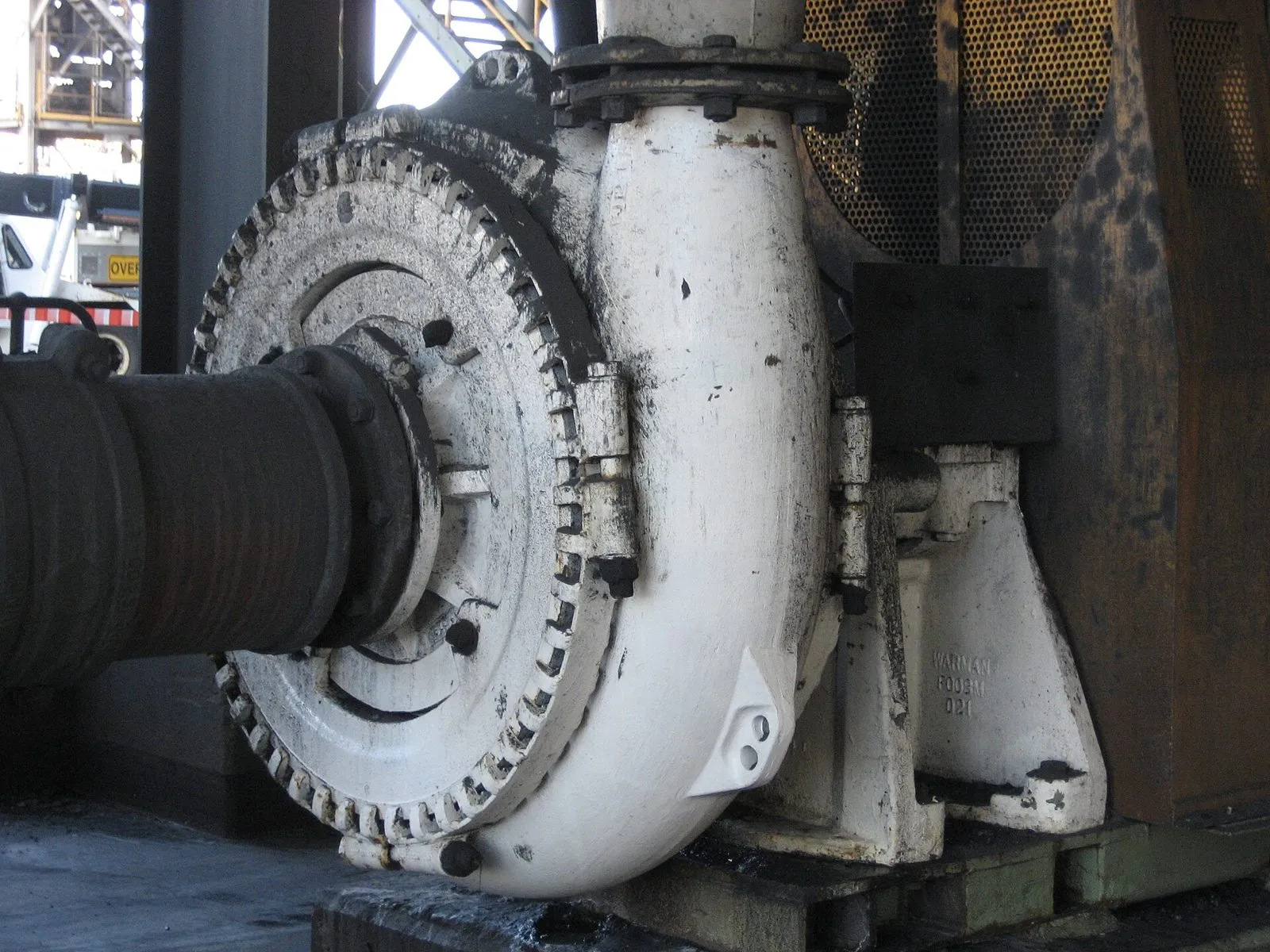
Technical explanations in this guide are based on the sources above: US DOE Mechanical Science handbooks (1993) and Motor Systems Tip Sheet #4, OSHA 29 CFR 1910.147, 1910.119 and 1910.252, UK HSE HSG250 and HSG253, and NIST SP 811. US and UK rules apply only in their own scope; follow your site's procedures and the standards of your project. Last checked on 27 November 2026. PeakTalk is not affiliated with the US DOE, OSHA, the UK HSE or NIST. Cover photo: “Warman centrifugal pump” by Bernard S. Janse, CC BY 2.5, resized, via Wikimedia Commons.

Frequently asked questions
- What English does a mechanical engineer need at work?
- Mostly working English: describing a fault and its likely cause, isolation and permit-to-work language, shift handovers, change requests, and numbers with the right units in reports. Short, clear sentences matter more than rare words.
- What is the difference between NPSH available and NPSH required?
- In the US DOE handbook, NPSH available is the difference between the pressure at the pump suction and the saturation pressure of the liquid. NPSH required is the minimum needed to avoid cavitation. To avoid cavitation, NPSH available must be greater than or equal to NPSH required.
- Is a tag the same as a lock?
- No. OSHA 1910.147 says tags are essentially warning devices and do not give the physical restraint that a lock gives. A tag shows that equipment may not be operated; a lock physically holds the isolating device in a safe position.
- What is the difference between a relief valve and a safety valve?
- The US DOE handbook explains it by how they open: a relief valve opens gradually as pressure rises above the setpoint, while a safety valve pops fully open at the set pressure and stays open until the pressure drops below a reset pressure. Industry standards use more detailed terms, so follow your project's documents.
- Should I write 10 bar or 10bar?
- Write 10 bar, with a space. NIST's SI guide says a space is left between the number and the unit symbol, even when the value is used as an adjective, for example a 10 bar test.