
ATC communication examples: pilot and controller radio calls, phase by phase
ATC (air traffic control) is the service on the other end of your radio. ICAO's PANS-ATM (Doc 4444) defines it as a service for "preventing collisions" between aircraft and between aircraft and obstructions on the manoeuvring area (the runways and taxiways), and for "expediting and maintaining an orderly flow of air traffic". On one IFR flight a pilot talks to several different controllers, and each phase has its own short set of phrases.
This guide walks through one example flight, from the first call on the stand to "runway vacated". We built it from the standard phrases in Chapter 12 of Doc 4444. G-ABCD, Northfield, Easton and the waypoint names are invented for this guide. After each phase you will find what to notice and, where it matters, how the same call sounds in the United States, quoted from FAA documents.
Who you talk to on one flight
ICAO Annex 10 Volume II (5.2.1.7.1.2) lists the call sign suffix for each unit. The jobs below are typical; they vary by airport and country.
| You call | What they do | Phase |
|---|---|---|
| Delivery | Gives your IFR route clearance | Before start-up |
| Ground | Start-up, pushback, taxi | On the ground |
| Tower | Line-up, take-off, landing | Runway |
| Departure / Approach | Climb out, vectors, approach | Near the airport |
| Control (US: Center) | Your route and levels en route | Cruise |
At smaller airports, one controller may do several of these jobs, and at some airports pushback is approved by the tower (Doc 4444, 12.3.4.4). In the US, the FAA AIM (4-3-18) notes that the IFR clearance is normally relayed by the ground controller, and pilots at busy airports may be told to "contact clearance delivery". At Northfield in our example, Ground gives the clearance.
A first call in the US follows this order (FAA AIM, 4-2-3): who you call, who you are, where you are (on the ground), what you want. For example: "Columbia Ground, Cessna Three One Six Zero Foxtrot, south ramp, I-F-R Memphis." On first contact, use your full callsign: Annex 10 says full call signs "shall always be used when establishing communication". Shorten it only after the controller has shortened it first (5.2.1.7.3.3.1). In the US, ATC does not shorten airline callsigns (FAA JO 7110.65, 2-4-9).
1. Start-up and route clearance
- Pilot: Northfield Ground, G-ABCD, stand 12, request start up, information Alpha
- ATC: G-ABCD, start up approved
- ATC: G-ABCD, cleared to Easton, LAMDA 1B departure, flight planned route, climb to flight level 80, squawk 4521
- Pilot: Cleared to Easton, LAMDA 1B departure, flight planned route, climb to flight level 80, squawk 4521, G-ABCD
What to notice:
- Start-up and pushback are "approved", not "cleared" (Doc 4444, 12.3.4.3 and 12.3.4.4). In Annex 10, APPROVED means "permission for proposed action granted"; CLEARED means "authorized to proceed under the conditions specified".
- "Information Alpha" tells the controller you have the latest ATIS (the recorded airport information).
- A route clearance is read back in full, with your callsign. If something is wrong in your readback, ATC corrects it. CAP 413 (2.67) adds that a route clearance "is NOT an instruction to take-off or enter an active runway".
In the US: the FAA AIM (5-2-6) gives this first call: "Washington clearance delivery (or ground control if appropriate) American Seventy Six at gate one, IFR Los Angeles." A typical clearance from the same section: "National Seven Twenty cleared to Miami Airport Intercontinental one departure, Lake Charles transition then as filed, maintain Flight Level two seven zero." JO 7110.65 (4-3-2) lists the items in this order: clearance limit, departure procedure, route, altitude. Some flight schools teach the memory aid "CRAFT" (clearance limit, route, altitude, frequency, transponder). It is a study aid, not a phrase you say on the radio.
2. Pushback and taxi
- Pilot: Northfield Ground, G-ABCD, request pushback
- ATC: G-ABCD, pushback approved
- Pilot: G-ABCD, request taxi
- ATC: G-ABCD, taxi to holding point A1 runway 27 via taxiway Bravo, hold short of runway 22
- Pilot: Taxi to holding point A1 runway 27 via Bravo, holding short of runway 22, G-ABCD
- ATC: G-ABCD, cross runway 22, report vacated
- Pilot: Cross runway 22, wilco, G-ABCD
- Pilot: G-ABCD, runway vacated
- ATC: G-ABCD, contact Northfield Tower 118.1
- Pilot: Northfield Tower 118.1, G-ABCD
What to notice:
- The holding point is your clearance limit: you stop there. If the taxi route goes past a runway, Doc 4444 (7.6.3.1.1.2) requires "an explicit clearance to cross or an instruction to hold short of that runway".
- If ATC says "hold short", answer "holding short". Doc 4444 (12.3.4.8) says "roger" and "wilco" are not enough for HOLD, HOLD POSITION and HOLD SHORT OF. In the UK, CAP 413 normally says "hold at" a holding point and uses "hold short" only in limited cases.
- ATC does not say "cleared to taxi". The FAA AIM (4-3-18) says ATC "will not use the word 'cleared' in conjunction with authorization for aircraft to taxi".
From the PeakTalk course, a taxi instruction with a condition:
- Pilot: Ground, G-ABCD, ready to taxi.
- ATC: Give way to the tug ahead, then taxi to holding point Alpha.
In the US: when ATC assigns a departure runway, the runway comes first. From the AIM (4-3-18):
- ATC: Beechcraft one three one five niner, Washington ground, runway two seven, taxi via taxiways Charlie and Delta, hold short of runway three three left.
- Pilot: Beechcraft One Three One Five Niner, runway two seven, hold short of runway three three left.
3. Line-up and take-off
- Pilot: Northfield Tower, G-ABCD, holding point A1, ready for departure
- ATC: G-ABCD, line up and wait
- Pilot: Line up and wait, G-ABCD
- ATC: G-ABCD, runway 27, cleared for take-off
- Pilot: Runway 27, cleared for take-off, G-ABCD
What to notice:
- Before the clearance, the pilot says "ready for departure", not "ready for take-off". CAP 413 says the words take-off "are only used when an aircraft is cleared for TAKE-OFF or when TAKE-OFF clearance is cancelled". This is a UK rule in CAP 413; Annex 10 and Doc 4444 (editions above) have no equivalent sentence. Our ATC phraseology guide explains why it matters, with Tenerife 1977.
- "Line up and wait" is not a take-off clearance. The FAA AIM (5-2-5) warns that "a significant number of pilots read back LUAW instructions correctly and departed without a takeoff clearance".
- Under ICAO rules, the take-off clearance is read back, with the runway number (Doc 4444, 4.5.7.5.1).
If ATC stops you (Doc 4444, 12.3.4.11):
- ATC: G-ABCD, stop immediately, G-ABCD, stop immediately
- Pilot: Stopping, G-ABCD
In the US: the controller says the runway first: "Runway two seven, cleared for takeoff" (FAA JO 7110.65, 3-9-10). The FAA writes "takeoff" as one word.
4. Departure and climb
- ATC: G-ABCD, contact Northfield Departure 124.5
- Pilot: Northfield Departure 124.5, G-ABCD
- Pilot: Northfield Departure, G-ABCD, passing altitude 2500 feet, climbing flight level 80
- ATC: G-ABCD, radar contact, climb to flight level 150, report reaching flight level 150
- Pilot: Climbing flight level 150, wilco, G-ABCD
What to notice:
- A frequency change is read back with the new frequency.
- On the first call to a new unit, give your level: what you are passing and what you are cleared to. Doc 4444 (4.11.3) lists these items for the initial call where the ATS authority requires it.
- "Report reaching" is a task for later, so "wilco" fits here, together with the readback of the level.
- Radar identification sounds different by country. ICAO (Doc 4444, 12.4.1.1) and the FAA use "radar contact"; CAP 413 uses "identified" and does not use "radar contact" at all.
In the US: "Climb and maintain five thousand. Expect niner thousand one zero minutes after departure" (FAA JO 7110.65, 4-3-2). An example from the PeakTalk course:
- Pilot: Metro Departure, Cessna 42K passing 1,500 feet climbing 3,000 feet.
- ATC: Cessna 42K, radar contact.
5. Cruise
- ATC: G-ABCD, contact Eastern Control 127.9
- Pilot: Eastern Control 127.9, G-ABCD
- Pilot: Eastern Control, G-ABCD, MOLEX 25, flight level 150, ROTAS 41
- ATC: G-CD, roger
- ATC: G-CD, advise if able to cross ROTAS at 45
- Pilot: Able, G-CD
- ATC: G-CD, cross ROTAS at 45 or later
- Pilot: Cross ROTAS at 45 or later, G-CD
- ATC: G-CD, descend to flight level 80, contact Easton Approach 119.3
- Pilot: Descend to flight level 80, Easton Approach 119.3, G-CD
What to notice:
- A position report has a fixed order. Doc 4444 (4.11.2.1) lists aircraft identification, position, time, level, and next position and time over. "MOLEX 25" means over MOLEX at minute 25; "ROTAS 41" is the estimate for the next point.
- Control shortened the callsign to G-CD first, so the pilot may use it with Control. On the first call to the next unit, the full callsign comes back.
- Voice position reports are mostly for airspace without radar. The FAA AIM (5-3-2) says pilots should stop them after "radar contact"; Doc 4444 (4.11.1.3) allows the ATS authority to exempt flights.
- Answer a direct question with "affirm" or "negative", not "roger". Annex 10 says ROGER is "under no circumstances" a reply to a question that needs a yes or no. From the PeakTalk course: "Do you have the runway in sight?" — "Affirm."
From the PeakTalk course, a direct routing in US style:
- ATC: N123AB, cleared direct KENET, climb and maintain flight level 280.
And a TCAS resolution advisory (callsign adapted from the PeakTalk course):
- ATC: G-EFGH, traffic alert, descend to FL170 immediately.
- Pilot: Unable, TCAS RA, climbing now.
6. Approach and landing
- Pilot: Easton Approach, G-ABCD, descending flight level 80, information Delta
- ATC: G-ABCD, vectoring for ILS approach runway 09
- Pilot: ILS approach runway 09, G-ABCD
- ATC: G-ABCD, turn left heading 120, descend to altitude 3000 feet, QNH 1008
- Pilot: Left heading 120, descend to altitude 3000 feet, QNH 1008, G-ABCD
- ATC: G-ABCD, turn right heading 060, report established on the localizer
- Pilot: Right heading 060, wilco, G-ABCD
- Pilot: G-ABCD, established on the localizer
- ATC: G-ABCD, cleared for ILS approach runway 09, contact Easton Tower 118.7
- Pilot: Cleared for ILS approach runway 09, Easton Tower 118.7, G-ABCD
- Pilot: Easton Tower, G-ABCD, final runway 09
- ATC: G-ABCD, runway 09, cleared to land, wind 080 degrees 10 knots
- Pilot: Runway 09, cleared to land, G-ABCD
What to notice:
- Headings, levels, the approach clearance, the runway and the QNH are all read back (Doc 4444, 4.5.7.5.1).
- "Final" and "long final" are defined reports. Doc 4444 (12.3.4.15) says "long final" is used when you turn final more than 4 NM (7 km) from touchdown, or at 8 NM (15 km) on a straight-in approach; "final" is then reported at 4 NM.
- Pressure is said digit by digit: "QNH one zero zero eight". Only 1000 hPa is said as "one thousand" (Annex 10, 5.2.1.4.1.3).
In the US: pressure is "altimeter three zero zero one" in inches of mercury (FAA JO 7110.65, 2-4-17), and the approach clearance sounds like "Cleared ILS Runway 27 Approach" (JO 7110.65, 4-8-1).
Go-around (Doc 4444, 12.3.4.18). CAP 413 (4.64) says transmissions to an aircraft going around should be brief, because workload is high:
- ATC: G-ABCD, go around
- Pilot: Going around, G-ABCD
If the pilot decides to go around, the pilot says "going around" too.
7. Vacating and taxi to the stand
- ATC: G-ABCD, take second right, when vacated contact Ground 121.8
- Pilot: Second right, when vacated Ground 121.8, G-ABCD
- Pilot: Easton Ground, G-ABCD, runway vacated
- ATC: G-ABCD, taxi to stand 5 via taxiway Alpha
- Pilot: Taxi to stand 5 via Alpha, G-ABCD
What to notice: say "runway vacated" once the whole aircraft is past the runway-holding position (Doc 4444, 12.3.4.9). In the US you will also hear "clear of the runway" (FAA AIM, 4-3).
Emergencies: MAYDAY and PAN PAN
ICAO Annex 10 Volume II (5.3.2.1.1) gives the distress call. MAYDAY comes first, "preferably spoken three times". Then as many of these items as possible, "if possible, in the following order":
- the station you are calling;
- your callsign;
- what is wrong;
- what you intend to do;
- your position, level and heading.
An urgency call (PAN PAN) has the same structure plus "any other useful information" (5.3.3.1.1). CAP 413 (8.13) adds aircraft type, pilot qualifications and people on board; the FAA AIM (6-3-2) adds aircraft type and weather.
A distress call, built from the Annex 10 order:
- Pilot: MAYDAY MAYDAY MAYDAY, Easton Approach, G-ABCD, engine fire, request immediate landing at Easton, 15 miles west of Easton, passing flight level 60, heading 090
- ATC: G-ABCD, roger MAYDAY
ATC's reply "roger MAYDAY" follows CAP 413 and the PeakTalk course.
An urgency call (PeakTalk course):
- Pilot: Pan-pan Pan-pan Pan-pan, Metro Tower, D-EFGH, passenger medical emergency, request priority landing.
- ATC: D-EFGH, roger pan-pan, runway 27 cleared to land.
Transponder codes 7700, 7600 and 7500 are "reserved internationally" for emergency, radio failure and unlawful interference (Doc 4444, 8.5.2.1). If ATC asks for "the nature of your emergency", answer in plain English. From the PeakTalk course: "Engine failure, descending to flight level one zero zero."
Four words that turn up in every phase
Annex 10 Volume II (5.2.1.5.8) gives each word a fixed meaning:
| Word | Meaning | Use it when |
|---|---|---|
| Roger | I have received all of your last transmission | ATC gives information, not an instruction |
| Wilco | I understand and will comply | ATC gives you a task for later, such as "report reaching" |
| Affirm / Negative | Yes / No (or not correct, not granted) | ATC asks a direct question |
| Unable | I cannot comply | You cannot follow an instruction (give a reason) |
The full list, with "say again", "confirm" and "standby", is in our ATC phraseology guide. If you are preparing for the language test, see ICAO English Level 4.
Common mistakes
- "Roger" to an instruction that needs a readback. A clearance, a level, a heading or a squawk is read back in full. "Roger" only says you heard it.
- No callsign in the readback. Annex 10 (5.2.1.7.3.3.3) says pilots "shall always add the call sign" when reading back a clearance. Without it, ATC cannot tell who answered.
- Shortening your callsign first. Wait until the controller shortens it.
- Treating "line up and wait" as a take-off clearance. Line up, then stop.
- "Wilco" to "hold short". Say "holding short".
Try it: 5 quick questions
- Ground says "G-ABCD, hold short of runway 22". Which reply follows ICAO phraseology?
- a) Roger, G-ABCD
- b) Holding short of runway 22, G-ABCD
- c) Wilco, G-ABCD
- Which unit normally gives you taxi instructions?
- a) Ground
- b) Approach
- c) Control
- In the UK, what does a pilot say when ready at the holding point?
- a) Ready for take-off
- b) Ready for departure
- c) Request take-off
- What does "line up and wait" allow you to do?
- a) Enter the runway and take off
- b) Enter the runway, line up and stop
- c) Cross the runway
- In the ICAO distress call, what comes right after the station you are calling?
- a) Your callsign
- b) Your position
- c) Your intentions
Answers: 1 b · 2 a · 3 b · 4 b · 5 a
Practise ATC English in PeakTalk
Sources
- ICAO Doc 4444 PANS-ATM, 16th edition (copy published by the Swiss FOCA)
- UK CAA — CAP 413 Radiotelephony Manual, Edition 24
- ICAO Annex 10 Volume II, 7th edition (copy published by the Swiss FOCA)
- FAA — Aeronautical Information Manual, Chapter 4 Section 2 (Radio Communications Phraseology and Techniques)
- FAA — Aeronautical Information Manual, Chapter 4 Section 3 (Airport Operations)
- FAA — Aeronautical Information Manual, Chapter 5 Section 2 (Departure Procedures)
- FAA — Aeronautical Information Manual, Chapter 5 Section 3 (En Route Procedures)
- FAA — Aeronautical Information Manual, Chapter 6 Section 3 (Distress and Urgency Procedures)
- FAA — JO 7110.65, Chapter 2 Section 4 (Radio and Interphone Communications)
- FAA — JO 7110.65, Chapter 3 Section 9 (Departure Procedures and Separation)
- FAA — JO 7110.65, Chapter 4 Section 3 (Departure Procedures)
- FAA — JO 7110.65, Chapter 4 Section 8 (Approach Clearance Procedures)
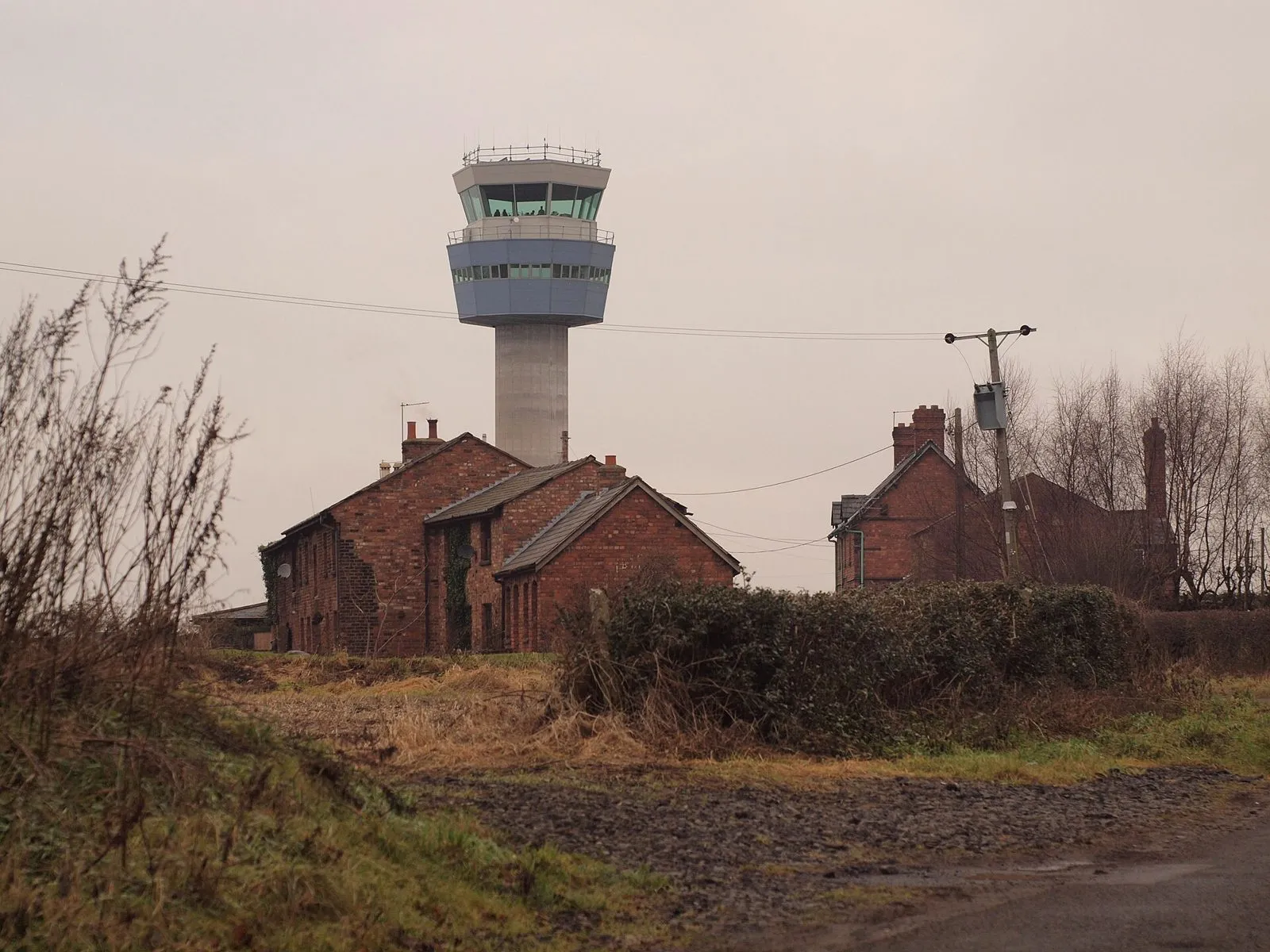
The example flight is our own, built from the phraseology in ICAO Doc 4444 (16th edition) with a made-up callsign and airports. US examples are quoted from the FAA AIM and JO 7110.65. Rules are from ICAO Annex 10 Volume II (7th edition) and Doc 4444 as published by the Swiss FOCA, with short quotes from the UK CAA CAP 413 (Edition 24), which has many more example exchanges in Chapter 11. Local rules can differ; follow your state's AIP and your operator. Last checked on 27 November 2026. PeakTalk is not affiliated with ICAO, the UK CAA or the FAA. Cover photo: “Air Traffic Control Tower - Liverpool” by SomeDriftwood, CC BY 3.0, resized, via Wikimedia Commons.

Frequently asked questions
- What is ATC in aviation?
- ATC (air traffic control) is a service that prevents collisions between aircraft, and between aircraft and obstructions on the manoeuvring area, and keeps traffic flowing in order. That is the ICAO definition in Doc 4444. A pilot talks to several units on one flight: Delivery, Ground, Tower, Departure or Approach, and Control (Center in the US).
- What must a pilot read back to ATC?
- Under ICAO Doc 4444 (4.5.7.5.1), pilots must always read back route clearances, any clearance to enter, land on, take off from, hold short of, cross, taxi or backtrack on a runway, and the runway in use, altimeter settings, squawk codes and level, heading and speed instructions. Add your callsign to every readback of a clearance.
- Are ATC communication examples like these real recordings?
- No. The main flight in this guide is our own example, built from the standard phrases in ICAO Doc 4444, with a made-up callsign and airports. The US examples come from the FAA AIM and JO 7110.65, and some exchanges from the PeakTalk course. Real radio is faster and less tidy, but the phrases are the standard ones.
- What does a pilot say in an emergency on the radio?
- Start with MAYDAY (distress) or PAN PAN (urgency), preferably three times. Then, if possible in this order: the station you are calling, your callsign, what is wrong, what you intend to do, and your position, level and heading. This is ICAO Annex 10 Volume II, 5.3. The UK and the FAA add items such as aircraft type.
- How is ATC communication in the US different?
- Several phrases differ. The FAA says "takeoff" without a hyphen and "altimeter three zero zero one" (inches of mercury) instead of "QNH 1008". When ATC assigns a departure runway, the taxi instruction starts with the runway, for example "runway two seven, taxi via taxiways Charlie and Delta". ATC also does not shorten airline callsigns (FAA JO 7110.65, 2-4-9).