
Aviation English: what it is, what the rules say and how to learn it
Aviation English is the English that pilots, controllers and other aviation staff use at work. For pilots and controllers it is also a licence requirement: if you use the radio, your licence must show your level in the language you use. On international routes, this language is often English. For other aviation jobs, the rules are different or less strict.
This guide explains what aviation English is, what ICAO, EASA and the FAA require, how it is tested, and what to learn for your job. Rules are quoted from the official texts (links at the end).
What is aviation English?
ICAO uses two meanings. In a wide sense, aviation language "could include all of the language uses of many different professions (engineers, technicians, commercial staff, flight crews, etc.)" (ICAO Doc 9835). The licence rules are much narrower:
"The sole object of ICAO language proficiency requirements is aeronautical radiotelephony communications, a specialized subcategory of aviation language corresponding to a limited portion of the language uses of only two aviation professions — controllers and flight crews. It includes ICAO standardized phraseology and the use of plain language."
So radio English has two parts:
- Standard phraseology: fixed phrases with one meaning, such as "line up and wait" or "unable".
- Plain English: normal sentences for everything the phrases do not cover, for example a sick passenger, a technical problem or a change of plan.
The licence level checks speaking and listening only. Doc 9835 says the ICAO rating scale "addresses only spoken language (speaking and listening); it does not address reading and writing skills". For the difference between the two parts and when to use each, see ATC phraseology vs plain English.
Why English?
ICAO does not make English the only language of the radio. ICAO Annex 10 says radio communications "shall be conducted in the language normally used by the station on the ground or in the English language". English "shall be available, on request from any aircraft station", at ground stations serving designated airports and routes used by international air services.
ICAO Doc 9835 explains the practical reason: "Because English is the most commonly used language for international aviation communications, many non-native speakers of English will require language training". It also says that "the burden for improved communications should not be seen as falling solely on non-native speakers". The rules apply to native speakers too.
Doc 9835 also notes a risk when two languages are used in the same airspace. Crews who do not understand all the languages on the frequency can lose situational awareness, and this "has been cited in several accident reports as a contributing factor".
Who must prove their English: the rules
ICAO
ICAO Annex 1, paragraph 1.2.9.4, says that as of 5 March 2008:
"aeroplane, airship, helicopter and powered-lift pilots, air traffic controllers and aeronautical station operators shall demonstrate the ability to speak and understand the language used for radiotelephony communications to the level specified in the language proficiency requirements in Appendix 1."
The minimum is Level 4 (Operational). Your overall level is the lowest of six criteria: pronunciation, structure, vocabulary, fluency, comprehension and interactions. Doc 9835: the final rating "is not the average or aggregate of the ratings in each of the six ICAO language proficiency skills but the lowest of these six ratings".
The requirement is about the language used on the radio. On domestic flights where pilots and controllers speak the local language, this ICAO rule does not require an English level. Doc 9835 says the requirements "apply to any language used in international aeronautical radiotelephony communications, but not to any language used in domestic operations".
For flight engineers and glider and balloon pilots, ICAO has only a recommendation. Cabin crew and maintenance engineers are not named in this part of Annex 1.
EASA (Europe)
EASA rules (FCL.055) make the level part of the licence. Pilots who use the radio "shall not exercise the privileges of their licences and ratings unless they have a language proficiency endorsement on their licence". The endorsement (an official note on the licence) shows "the language, the proficiency level and the validity date".
Two points go further than ICAO:
- Fixed re-evaluation periods are mandatory: "every 4 years" for Level 4 and "6 years" for Level 5. Level 6 is not re-evaluated. (ICAO's standard requires evaluation "at intervals" according to your level; it only recommends "at least once every three years" for Level 4 and every six years for Level 5.)
- Instrument rating (IR): IR holders "shall have demonstrated the ability to use the English language". EASA guidance (AMC3 FCL.055) explains that this includes reading technical manuals, using charts and NOTAMs in English, and talking to other crew members in English.
The test is done by "an assessor certified by a competent authority or a language-testing body approved by a competent authority". In other words, your national authority decides who can test you, not EASA itself.
FAA (United States)
US rules are short. A private pilot applicant must "be able to read, speak, write, and understand the English language" (14 CFR 61.103). The same words appear in the rules for student, commercial and airline transport pilots. Unlike the ICAO scale, this includes reading and writing.
FAA guidance (AC 60-28B) links this to ICAO: the FAA English standard "should be applied to no less than the ICAO Operational Level 4". An "English Proficient" endorsement on a pilot certificate "indicates the airman was evaluated to have the equivalent of a minimum ICAO Operational Level 4". English is checked during normal events, such as the practical test or a flight review. The AC does not describe a separate language exam. Note that the AC itself says it is "a guidance document" and "not legally binding in its own right".
In short:
- Minimum level. ICAO: Level 4. EASA: Level 4. FAA: an English standard applied at no less than Level 4 (guidance).
- Level 4 re-evaluation. ICAO: evaluation "at intervals" (standard); "at least once every three years" is a recommendation. EASA: "every 4 years" (rule). FAA: no fixed interval in AC 60-28B.
- Reading and writing. ICAO: not part of the scale. EASA: part of the IR English requirement. FAA: "read, speak, write, and understand".
- Who tests. ICAO: the licensing authority decides. EASA: an assessor or testing body approved by the national authority. FAA: examiners and instructors during normal checks.
For the six criteria, the test format and a preparation plan, see our guide to ICAO English Level 4.
Is there one ICAO English test?
No. ICAO Annex 1 says a licence holder shows proficiency "in a manner acceptable to the licensing authority" (the national authority that issues your licence). Each country chooses which tests it accepts. Under EASA guidance, for example, the authority "may use its own resources" to run the assessment "or may delegate this task to language testing bodies".
ICAO does have a voluntary service, the Aviation English Language Test Service (AELTS). It can recognise tests "designed specifically for aviation and that meet ICAO's Language Proficiency Requirements". ICAO says that this recognition does not replace the national decision: "Compliance with licensing requirements in relation to English language proficiency remains the sole responsibility of the aeronautical authorities of the State concerned."
Practical advice: before you book a test, check on your aviation authority's website which tests it accepts for your licence. General English tests are a different thing. ICAO Doc 9835 says that "existing academic or general-purpose language tests are not appropriate for the specialized domain of aviation language testing".
What to learn for your job
Pilots
Radio English (phraseology, numbers, readback), plain English for non-routine situations, and the vocabulary to describe the aircraft and the weather. Examples from PeakTalk courses:
- "Is the aircraft in landing configuration?"
- "Fuel consumption is higher than planned."
- "We had to miss the approach due to windshear."
- "The first officer said the roll control felt sluggish after the aircraft left the cloud."
The last sentence is plain English that you might need in an ICAO test task or when you report a problem: no standard phrase describes it.
Air traffic controllers
The same ICAO requirement applies to controllers. Between ATC units, ICAO Annex 11 (as reproduced in Doc 9835) says that "except when communications between air traffic control units are conducted in a mutually agreed language, the English language shall be used".
Cabin crew
Cabin crew are not named in the ICAO language requirements in Annex 1 (1.2.9). Your airline or authority may set its own language rules. EASA cabin crew training must stress "effective communication between cabin crew and flight crew, including communication techniques, common language and terminology". Typical work English covers safety briefings, passengers who need help and medical situations:
- "Only able-bodied passengers can sit in exit rows."
- "We have a passenger with sudden illness."
- "Wait for my signal before you disarm the door."
Maintenance engineers
Maintenance engineers are not named in those ICAO requirements either, but the documents matter. Under EASA Part-66, a licence holder may not use the licence privileges unless they can "read, write and communicate to an understandable level in the language(s) in which the technical documentation and procedures necessary to support the issue of the certificate of release to service are written". In the US, a mechanic applicant must be able to "read, write, speak, and understand the English language" (14 CFR 65.71, with an exception for people employed abroad by a US air carrier). Examples:
- "We need to inspect the airframe after that turbulence."
- "There's an anomaly in the fuel flow reading."
- "Can you explain why the fuel flow is low?"
Try it: 5 quick questions
- Which skills does the ICAO rating scale assess?
- a) Reading and writing
- b) Speaking and listening
- c) All four skills
- Your ratings are Level 5 in five criteria and Level 3 in pronunciation. What is your overall level?
- a) Level 3
- b) Level 4
- c) Level 5
- Under EASA rules, how often must Level 4 be re-evaluated?
- a) Every 3 years
- b) Every 4 years
- c) Never
- Who decides which English test is accepted for your licence?
- a) ICAO
- b) The test company
- c) Your national licensing authority
- According to ICAO Annex 10, which language can be used on the radio?
- a) Only English
- b) The language of the ground station, or English
- c) Any language the pilot chooses
Answers: 1 b · 2 a · 3 b · 4 c · 5 b
How to start
- Check your rules. Find out which level you need, when your endorsement expires and which tests your authority accepts.
- Fix the basics of radio English. Standard words, numbers, readback.
- Practise plain English out loud. Describe a technical problem, a weather change or a passenger situation for one minute, in simple sentences.
- Learn the vocabulary of your job. Systems and weather for pilots, safety and service for cabin crew, documents and faults for engineers.
Practise aviation English in PeakTalk
Sources
- ICAO Doc 9835, Manual on the Implementation of ICAO Language Proficiency Requirements, 2nd edition (includes Annex 1, 1.2.9 in Appendix A)
- ICAO Annex 10, Volume II, 7th edition (copy published by the Swiss FOCA)
- EASA — Easy Access Rules for Aircrew (Regulation (EU) No 1178/2011), FCL.055
- EASA — Easy Access Rules for Continuing Airworthiness (Regulation (EU) No 1321/2014), 66.A.20
- US 14 CFR 61.103 — eligibility requirements for a private pilot certificate
- US 14 CFR 65.71 — eligibility requirements for a mechanic certificate
- FAA — AC 60-28B, FAA English Language Standard
- ICAO — Aviation English Language Test Service (AELTS)
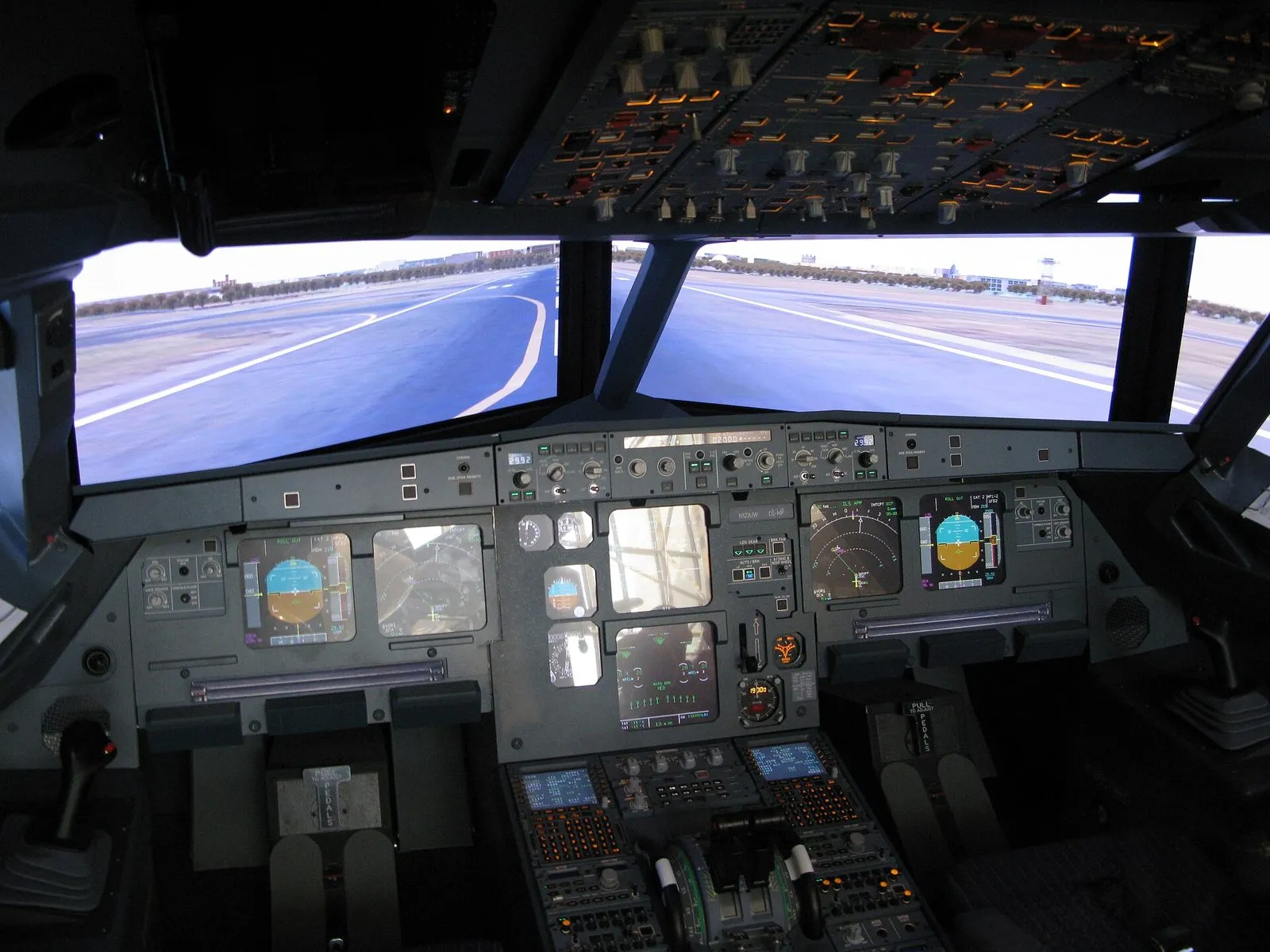
This guide is based on ICAO Doc 9835 (which reproduces the Annex 1 language provisions), ICAO Annex 10 Volume II, EASA Part-FCL and Part-66, US 14 CFR Part 61 and Part 65, FAA AC 60-28B and the ICAO AELTS website (links above). Last checked on 25 November 2026. PeakTalk is not affiliated with ICAO, EASA or the FAA. Cover photo: “Airbus A320 Glass Cockpit” (simulator) by Steve Jurvetson, CC BY 2.0, resized, via Wikimedia Commons.

Frequently asked questions
- What is aviation English?
- It is the English used in aviation work. The narrow meaning is radiotelephony between pilots and controllers: standard ICAO phraseology plus plain English for situations that phraseology does not cover. This is what the ICAO language proficiency requirements are about. In a wider sense, aviation English is also the English of cabin crew, engineers and other aviation staff.
- Who needs ICAO English Level 4?
- Under ICAO Annex 1, aeroplane, airship, helicopter and powered-lift pilots, air traffic controllers and aeronautical station operators must show Level 4 for the language they use on the radio. In practice, English is the language most often used on international radio. Cabin crew and maintenance engineers are not named in this list.
- Is there one official ICAO English test?
- No. ICAO Annex 1 says proficiency is shown "in a manner acceptable to the licensing authority", so each country decides which tests it accepts. ICAO runs a voluntary service (AELTS) that can recognise individual tests, but it says that licensing remains "the sole responsibility" of each state's aviation authority.
- How long is ICAO Level 4 valid?
- ICAO recommends a new evaluation at least every 3 years for Level 4 and every 6 years for Level 5; Level 6 needs no new evaluation. Under EASA rules, Level 4 must be re-evaluated every 4 years and Level 5 every 6 years. Check your own authority's rules.
- Do US pilots need ICAO Level 4?
- Not as a law. US rules (for example 14 CFR 61.103) require pilots to "read, speak, write, and understand the English language". FAA guidance (AC 60-28B) says this standard should be applied to "no less than the ICAO Operational Level 4", and an "English Proficient" endorsement on the certificate shows that. The AC itself says it is "a guidance document" and "not legally binding in its own right".