
ICAO English test sample: six task types and how Level 4 and Level 5 answers differ
There is no single "ICAO English test": providers build tests against ICAO's rating scale, and your authority decides which ones it accepts (our ICAO English Level 4 guide explains the scale and validity). The tests we checked (ELPAC, TEA and RELTA) look different, but most of their speaking tasks fall into a few types.
This guide shows six task types with practice prompts written by us, example answers at Level 4 and Level 5, and what raters listen for. It does not contain real test questions. ICAO's manual on language proficiency, Doc 9835, asks providers to keep test questions "in confidence" (6.3.5.10), and memorised answers do not help: the tests are built so you cannot "directly prepare or study (by memorizing information, for example)" for them (6.2.5.4).
What every test checks
Doc 9835 gives guidance for tests used for licensing. The main points:
- Speaking and listening only. Testing "should focus on speaking and listening proficiency" (6.2.8.2). No reading, writing or grammar quizzes.
- Plain English, not phraseology. A test may use phraseology to set the scene, but it "should not be designed to assess phraseology" (6.3.2.9).
- Not technical knowledge. The test "should not be designed to evaluate the technical knowledge of operations" (6.3.2.10). TEA's guide adds that there are "no extra marks to be gained from talking about correct operational procedures".
- Routine and unexpected situations. You are judged on language "related to routine as well as unexpected or complicated situations" (6.2.7.7).
- The lowest score decides. Your level is "the lowest of these six ratings", not the average (6.3.2.11). Doc 9835 recommends at least two raters for licensing (6.3.4.2); ELPAC, for example, uses two assessors.
Official samples you can try
The best practice material is the provider's own sample. Doc 9835 (6.3.5.1) says "a complete sample of the test should be published" so candidates know the format.
| Test | Format | Sample |
|---|---|---|
| ELPAC (EUROCONTROL) | Listening paper (45 items); live speaking, about 20 min, two assessors | Free, no login |
| TEA (Mayflower College) | 25–30 min, one examiner: interview, listening, pictures | Sample test on tea-test.com |
| RELTA (RMIT) | 30-min speaking and 40-min listening, on computer | Practice test after registration |
Formats are from each provider's own pages.
On 27 November 2026, ICAO's AELTS list of recognized tests showed two tests: ELPAC Pilot and ELPAC ATC. TEA and RELTA were not on it; their providers state that they meet ICAO requirements, and TEA says it is approved by the UK CAA. AELTS recognition does not replace the decision of your authority. ELPAC says its recognition is valid through 31 December 2026, and a new evaluation is in progress. TEA's candidate notes put it simply: "It is your responsibility to check that your licence-issuing authority accepts a TEA certificate."
Six speaking task types, with practice prompts
The prompts below are ours. They follow the task types that ELPAC, TEA and RELTA describe on their own pages. The example answers are written texts, so they show only structure and vocabulary. A real rating also covers pronunciation, fluency, comprehension and interactions, and it is based on speech. They are not rated samples. Besides speaking, ELPAC and RELTA also have a separate listening test with its own questions.
1. Interview about your work
The examiner asks about your role and experience, then about an aviation topic. TEA calls this the "Introduction & Experience-related Interview" (7–8 minutes) and says "there are no right or wrong answers".
Practice prompt: "Tell me about a flight when the weather was different from the forecast. What did you do?"
Level 4 example answer (our illustration):
We departed in the morning, and the forecast said light rain. After one hour the clouds became very low at our destination. I asked ATC for the latest weather. Visibility was under the minimum, so we decided to go to the alternate. We landed there about forty minutes later.
Level 5 example answer (our illustration):
The forecast had only mentioned light rain, so the low cloud at our destination came as a surprise. When we got the latest observation, visibility had already dropped below our minimum, and it was getting worse. Since our fuel allowed it, we diverted to the alternate rather than holding and hoping it would improve.
What changed: both answers are clear and would be understood. The Level 4 answer uses basic sentences, one after another. The Level 5 answer uses complex structures ("had only mentioned", "since our fuel allowed it", "rather than…") and connects ideas. That matches the scale: Level 4 uses basic structures "usually well controlled"; at Level 5 "complex structures are attempted but with errors which sometimes interfere with meaning". Doc 9835 (Appendix B, Part IV) lists "since" clauses and conditionals as complex structures.
2. Understand a non-routine message and say what it was
You hear a short recording of a pilot or controller in an unusual situation. Then you report the message in your own words and say who was speaking. This is TEA's Part 2A; ELPAC's speaking paper includes "an unusual situation on the radiotelephony frequency".
Practice prompt: You hear: "Approach, we have a passenger with chest pain, a doctor on board is with him, we'd like to continue to destination but may need priority." What was the message, and who was speaking?
A good answer (our illustration): "It was a pilot. A passenger has chest pain and a doctor is helping him. The crew wants to continue to the destination, but they may ask for priority."
What raters listen for: all the key details (who, what, what they need) in your own words, not word-for-word. If you missed something, ask: "Could you repeat the part about the doctor?" TEA warns that "regular repetition will suggest that your Comprehension is slower", so ask for specific parts, not the whole message.
3. Longer message: note the problem, the request and the details
TEA's Part 2B uses "longer recordings in which a pilot or controller describes a problem, says what they need, and gives some extra details". You take notes and report back.
Practice prompt: "Tower, we have a hydraulic problem, the gear came down using the alternate system, we'd like the fire services standing by for landing, and we'll need a tow after we stop on the runway."
Report: problem (hydraulic failure; gear down by the alternate system), request (fire services standing by), extra detail (the aircraft will stop on the runway and needs a tow).
4. Ask questions to find out more
You hear a short message and have a few seconds to ask the speaker questions. In TEA's Part 2C you get "20 seconds to ask the speaker questions to find out more about the situation".
Practice prompt: "Ground, one of our passengers has left her bag in the terminal and wants to get off."
Good questions (our illustration): "Is the aircraft still at the gate?" "Has the bag been checked by security?" "Do you want to return to the stand?"
What raters listen for: quick, relevant questions. This is the interactions criterion: Level 4 "initiates and maintains exchanges even when dealing with an unexpected turn of events".
5. Describe a picture, then discuss
You describe one or two aviation pictures, then answer questions, give opinions and speculate. TEA's third part is "Picture Description and Discussion" (10 minutes); ELPAC's speaking paper has "picture description with hypothesising and problem-solving".
Practice prompt: A picture shows a small aircraft on the grass next to a runway, with a fire truck beside it. Describe it, then say what might have happened.
Level 4 example answer (our illustration):
In the foreground there is a small aircraft. It is on the grass, not on the runway. Behind it there is a fire truck. I think the aircraft had a problem on landing, maybe a strong crosswind or a brake problem, and it left the runway. Nobody looks injured.
Level 5 example answer (our illustration):
The aircraft seems to have run off the side of the runway, since it's sitting on the grass with the fire truck already beside it. It could have been a gust during the flare, or perhaps the brakes failed on one side and pulled it off the centreline. If the runway is closed now, arriving traffic will probably have to hold or divert.
What changed: the Level 5 answer adds reasons and consequences ("since…", "if…, … will probably") and more specific words ("gust", "flare", "centreline"). The specific words are our observation; for vocabulary, the scale looks at paraphrasing: Level 5 "paraphrases consistently and successfully".
6. Radio role-play that turns into plain English
Some tests start with a radio exchange in standard phraseology and then add a complication you must handle in plain English. RELTA uses headsets for its "role-played radiotelephony components"; ELPAC's speaking paper starts with "standard phraseology and an unusual situation". Doc 9835 (6.2.8.8) says phraseology here is a way to set "a radiotelephony context in which to elicit plain language responses" (elicit = get).
Practice prompt: You are on approach. ATC says: "Report your intentions, the runway is blocked by a disabled aircraft, expect at least 30 minutes delay."
A good answer (our illustration): "We can hold for about twenty minutes with our fuel. After that we'll need to divert to our alternate. Can you tell us if the delay is likely to be longer than thirty minutes?"
What raters listen for: a clear decision, a reason, and a question when you need information. Silence is risky. Doc 9835 (4.6.7) says it is "much safer to query a communication, to clarify, or even to simply acknowledge that one does not understand rather than to allow silence to mistakenly represent comprehension".
Level 4, 5 and 6: what actually changes
Doc 9835 explains each level in plain words (4.6.2–4.6.7). Here are three criteria where the difference is easiest to hear:
| Criterion | Level 4 | Level 5 |
|---|---|---|
| Structure | Basic grammar "usually well controlled"; errors "rarely interfere with meaning" | Basic grammar "consistently well controlled"; complex structures attempted |
| Vocabulary | "Can often paraphrase successfully" when a word is missing | "Paraphrases consistently and successfully"; "sometimes idiomatic" |
| Comprehension | In unexpected situations, may be slower or "require clarification strategies" | "Mostly accurate" in unexpected situations; understands a range of accents |
On structure, Doc 9835 says: "There is actually a big jump between Level 4 and Level 5." It also says in the pronunciation notes that "Operational Level 4 is certainly not a perfect level of proficiency; it is the minimum level of proficiency determined to be safe for air traffic control communications". For the licence, Level 4 is enough. Do not add complex sentences if you cannot control them: clear basic grammar matters more.
Level 6 (Expert) means, for example, "a wide variety of familiar and unfamiliar topics" and comprehension that is "consistently accurate in nearly all contexts". Three facts help set expectations:
- Doc 9835 (4.5.9) says Level 6 "should be considered as being beyond the realistic expectations of most second- or foreign-language learners", and that it is "not an indispensable requirement for successful aeronautical communication".
- Native speakers are not Level 6 automatically. The UK CAA says "'first-language English speaker' does not necessarily mean 'Expert Level 6' user", and Doc 9835 (4.6.2) notes a native speaker with a very local accent can rate lower on pronunciation.
- Idioms are a Level 6 marker in general conversation, but on the radio Doc 9835 (4.6.4) says idioms are "an obstacle to intelligibility" that "should therefore be avoided by all users".
Under EASA's FCL.055, Level 6 is not re-evaluated. For Level 4 and Level 5 validity, see our ICAO English Level 4 guide.
Common mistakes
- A technical lecture. Long explanations of systems do not raise your score; clear plain English does.
- Learning answers by heart. The examiner asks follow-up questions about what you said, so a memorised answer stops working. Practise the task types with new prompts instead. Doc 9835 (7.4.3) says the same about phraseology: "Memorization of ICAO phraseologies alone does not constitute language proficiency and is an unsafe practice."
- Asking for the whole message again. Ask for the specific part you missed.
Examples from PeakTalk courses
The ICAO Test Prep course practises the language of these tasks. A few cards:
- in other words: "The examiner may ask you to describe the same problem in other words."
- simplify: "The examiner looked unsure, so I simplified my answer: the aircraft shook only during taxi."
- foreground: "What can you describe first? — In the foreground, a student pilot is checking a map beside a small aircraft."
- drift: "What happened during the crosswind landing? — The light aircraft began to drift left of the centreline before touchdown."
- go over: "Could we go over that again before I answer the examiner?"
Try it: 5 quick questions
- How is your final ICAO level decided?
- a) The average of the six ratings
- b) The lowest of the six ratings
- c) The highest of the six ratings
- According to Doc 9835, what should the test not be designed to assess?
- a) Phraseology
- b) Listening
- c) Interaction
- On 27 November 2026, which tests were on ICAO's AELTS list?
- a) ELPAC Pilot and ELPAC ATC
- b) TEA and RELTA
- c) All aviation English tests
- In the interview example, what separates the Level 5 answer from the Level 4 answer?
- a) Idioms
- b) Complex structures such as "since…" and "rather than…"
- c) Speed
- You don't understand part of a message. What should you do?
- a) Stay silent and wait
- b) Guess and continue
- c) Ask for the specific part again
Answers: 1 b · 2 a · 3 a · 4 b · 5 c
Practise aviation English in PeakTalk
Sources
- ICAO Doc 9835 — Manual on the Implementation of ICAO Language Proficiency Requirements, 2nd edition (2010)
- ICAO — Aviation English Language Test Service (AELTS), list of recognized tests
- EUROCONTROL — ELPAC: about the test
- EUROCONTROL — ELPAC sample tests
- EUROCONTROL — ELPAC and ICAO Doc 10197
- EUROCONTROL — ELPAC: ICAO AELTS recognition
- Mayflower College — TEA, Test of English for Aviation
- Mayflower College — TEA Notes for Candidates, v5.0
- RMIT University — RELTA, RMIT English Language Test for Aviation
- EASA — Easy Access Rules for Aircrew (Regulation (EU) No 1178/2011), FCL.055
- UK CAA — English language proficiency testing and flight crew licensing
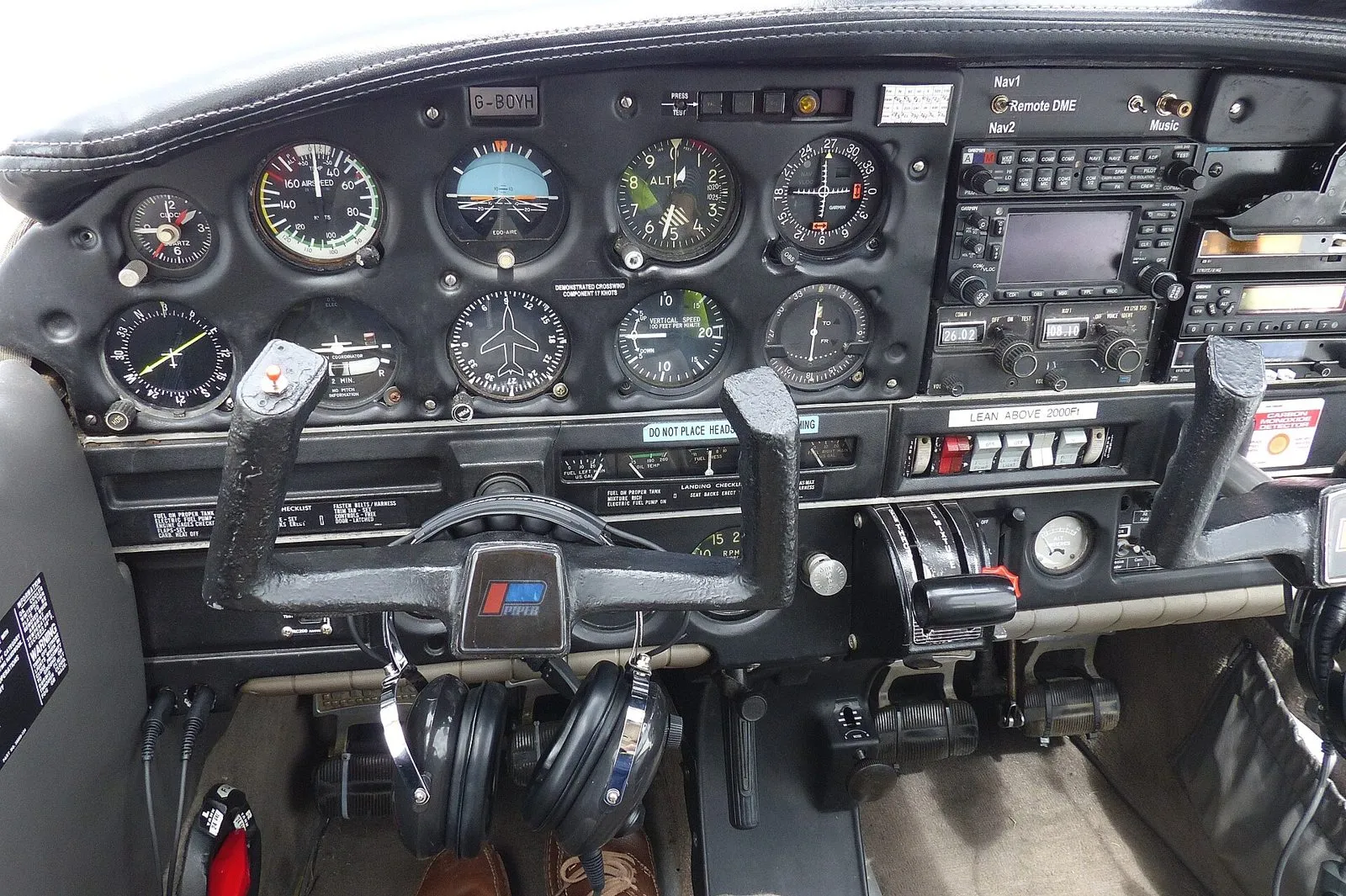
Based on ICAO Doc 9835 (2nd edition), the ICAO AELTS list, the providers' own pages for ELPAC, TEA and RELTA, EASA FCL.055 and the UK CAA. Practice prompts and example answers are our own illustrations, not official rated samples or real test questions. Last checked on 27 November 2026. PeakTalk is not affiliated with ICAO, EUROCONTROL, Mayflower College, RMIT University, EASA or the UK CAA. Cover photo: Piper PA-28-151 cockpit by Adrian Pingstone, public domain, via Wikimedia Commons.

Frequently asked questions
- Is there an official ICAO English test?
- No. ICAO writes the rating scale, and each licensing authority decides which tests it accepts. ICAO's AELTS service reviews tests against its requirements; on 27 November 2026 its list showed two: ELPAC Pilot and ELPAC ATC. Check with your own authority which tests it accepts.
- Where can I find an ICAO English test sample?
- From the test providers. EUROCONTROL publishes free ELPAC sample tests for pilots and controllers, with no login. TEA's candidate notes point to a sample test on tea-test.com, and RELTA offers a practice test after registration. ICAO's Doc 9835 asks providers to publish a complete sample but to keep real test questions confidential.
- What is the difference between ICAO Level 4 and Level 5?
- At Level 4 you control basic grammar, paraphrase often when a word is missing, and use clarification to deal with the unexpected. At Level 5 basic grammar is consistently controlled, you try complex structures, and you paraphrase consistently. Doc 9835 calls the step in structure "a big jump".
- Does ICAO Level 6 expire?
- Under ICAO rules and EASA's FCL.055, Level 6 is not re-evaluated, while Level 4 and Level 5 are (EASA: every 4 and 6 years). Being a native speaker does not make you Level 6 automatically: the UK CAA says a first-language speaker is not necessarily an expert user.
- Does the ICAO English test check phraseology?
- Not as its goal. Doc 9835 says a test may use phraseology in a prompt, but it "should not be designed to assess phraseology". It should not test technical knowledge either. The test checks plain English: speaking and listening in work-related and unexpected situations.