
English for project managers: vocabulary for meetings, status reports and stakeholders
A project manager talks all day: to the team, to the sponsor, to suppliers, to clients. In an international team, much of that talk is in English — and the words are surprisingly specific. "We are slightly behind" and "the project is at risk" do not mean the same thing to a sponsor.
This guide gives you the core project management vocabulary grouped by situation: status updates, scope and change, risks and issues, stakeholders, meetings and Scrum events. The Scrum terms are quoted from the Scrum Guide; the example sentences come from two PeakTalk courses, English for IT Project Managers and English for Project Managers (oil and gas). At the end you will find notes on the PMP and PRINCE2 exams, common mistakes and a quiz.
Status words: on track, at risk, behind schedule
A status update should answer one question first: are we on plan? Three phrases do most of the work:
| Phrase | What it tells the listener |
|---|---|
| on track | We will meet the plan (dates, budget, scope) |
| at risk | We may miss the plan unless something changes |
| behind schedule | We are already late |
Many teams show these as green, amber and red (often called RAG status). Our advice: never say "on track" if you already know about a problem; say "at risk" and explain what you need.
From the courses:
- "We invited a key stakeholder to the sprint review to confirm the project is on track."
- "The project is behind schedule because we lost two days due to high winds."
- "The sponsor asked for a brief update on project risks and the budget during the steering committee meeting."
- "The project sponsor asked for a clear explanation of the schedule variance."
A simple status update (our template):
Overall status: amber.
Done this week: integration tests passed; supplier contract signed.
Next week: data migration rehearsal.
Risks and issues: the security review may slip by three days, which would delay the critical path.
Decision needed: approve two extra days of testing by Wednesday.
Scope, deliverables and change
- scope — the work the project has agreed to do. "Confirm the scope of work before you start, so we don't duplicate work."
- deliverable — something the project must produce and hand over. "The deliverables list includes drawings, certificates, and test reports."
- milestone — an important point in the schedule. "Factory acceptance testing is the next milestone in the project schedule."
- dependency — one task needs another one first. "The installation schedule has a dependency on the crane being available on site."
- critical path — the longest chain of linked tasks; it sets the earliest end date. "This task is on the critical path, so any delay will push back the whole schedule."
- buffer / contingency — extra time or money kept for surprises. "We added a buffer of three days for unexpected testing issues."
- change request — a formal request to change scope, time or cost. "Before we approve the change request, we check the safety impact and the cost for the project."
- scope creep — scope that grows without agreement. "To avoid scope creep, we only accept changes that are approved through the change control process."
Risks and issues
The difference is time. A risk may happen in the future; an issue is happening now. You plan a mitigation for a risk and keep a contingency plan in case it happens. You resolve an issue — or escalate it if you cannot.
- "There is a risk that the vendor API will change without notice."
- "As a mitigation, we will add contract tests to catch breaking changes early."
- "If the deployment fails, our contingency plan is to roll back to the previous release."
- "The risk register lists each risk, its owner, the mitigation plan, and the due date."
- "We review the RAID log every week so risks, assumptions, issues, and dependencies are clearly tracked."
- "The missing drawing is a blocker and is delaying the installation on Line 12."
- "If the supplier does not respond within the agreed time, follow the escalation path in the contract."
Stakeholders, sponsor and sign-off
- stakeholder — anyone affected by the project or able to influence it.
- sponsor — the senior person who backs the project and usually provides the money or resources. The exact role differs from company to company.
- steering committee — the senior group that makes key decisions about the project.
- RACI — a matrix of who is Responsible, Accountable, Consulted and Informed. "Use the RACI matrix to clarify who is responsible, accountable, consulted, and informed for each project task."
- sign-off — formal approval. "Once we get sign-off from the Product Manager, we can share the specification with external partners."
Meeting language
- "At the kickoff meeting, we will review the goals, assign roles, and confirm the high-level plan."
- "I sent the meeting agenda so everyone knows what we need to decide today."
- "Let's keep the meeting focused on decisions and next steps, not detailed troubleshooting."
- "I will send the meeting minutes, including action items and due dates, by the end of the day."
- "We reviewed the issue log and agreed on next steps for each item."
Agile and Scrum terms: what the Scrum Guide says
If your team uses Scrum, use the words the way the Scrum Guide (November 2020) defines them:
- Sprint — "fixed length events of one month or less to create consistency"
- Product Backlog — "an emergent, ordered list of what is needed to improve the product"
- Sprint Backlog — the Sprint Goal (why), the selected Product Backlog items (what) and "an actionable plan for delivering the Increment (how)"
- Increment — "a concrete stepping stone toward the Product Goal"
- Definition of Done — "a formal description of the state of the Increment when it meets the quality measures required for the product"
- Daily Scrum — "a 15-minute event for the Developers of the Scrum Team"
- Sprint Review — inspects "the outcome of the Sprint" and determines future adaptations
- Sprint Retrospective — plans "ways to increase quality and effectiveness"
Two points to remember:
- The Daily Scrum is for the Developers, and "the Developers can select whatever structure and techniques they want". Some teams use a three-part format, like this course sentence: "During the stand-up, I shared what I finished yesterday, what I'm working on today, and any blockers." But the Scrum Guide does not require it.
- The Sprint Review "is a working session and the Scrum Team should avoid limiting it to a presentation."
Phrases for difficult conversations
Our examples, built on the course vocabulary:
- Saying no to extra scope: "We can add this feature, but it is outside the agreed scope. Could you raise a change request so we can check the impact on time and cost?"
- Reporting a delay early: "I want to flag a risk: the supplier may deliver the parts five days late. If that happens, the go-live moves to the 14th. Our mitigation is to install the other units first."
- Asking for a decision: "We need a decision by Friday: option A keeps the date but drops two reports; option B keeps the scope but moves the date by a week."
- Escalating politely: "We have tried to resolve this at team level since Monday. I'd like to escalate it to the steering committee, as it now affects the critical path."
PMP and PRINCE2: the exams in brief
PMP. PMI's current Examination Content Outline (July 2026) has three domains: People (33%), Process (41%) and Business Environment (26%). The exam has 180 questions, 10 of them unscored pretest questions, and 240 minutes for the center-based exam. Communication runs through the tasks, for example "Analyze and tailor communication to stakeholder needs" and "Communicate project status". PMI's Certification Handbook (June 2026) says "All PMI exams are available in English" and that some are translated "in up to 15 languages"; the PMP is one of them, and an on-screen button shows each question in English. The current PMBOK Guide is the Eighth Edition (ANSI/PMI 99-001-2025).
PRINCE2. For PRINCE2 Version 7, PeopleCert lists the exams in 14 languages. The Foundation exam has 60 multiple-choice questions in 60 minutes, closed book, with a pass mark of 60%. The Practitioner exam has 56 questions and sub-questions worth 70 marks, 150 minutes, open book, with a pass mark of 60%.
Common mistakes
- "On track" as a polite answer. If you know about a risk, say "at risk". Bad news early is better than bad news late.
- Mixing up risk and issue. "We have a risk: the server is down" — no. If the server is already down, it is an issue, not a risk.
- "Deadline" for every date. A deadline is the date by which work must be finished. A milestone marks an important point in the plan, such as the end of a phase. Not every milestone is a deadline, so say which one you mean.
- Vague asks. "Please support us" does not get a decision. Say what you need, from whom and by when.
Try it: 5 quick questions
- The project will probably miss the date unless the team gets more testers. What is the status?
- a) On track
- b) At risk
- c) Closed
- The test server crashed this morning and the team cannot work. Is this a risk or an issue?
- a) A risk
- b) An issue
- c) A milestone
- According to the Scrum Guide, how long is the Daily Scrum?
- a) 15 minutes
- b) 1 hour
- c) Four hours
- Which term means scope that grows without agreement?
- a) Critical path
- b) Buffer
- c) Scope creep
- How many languages does PeopleCert list for the PRINCE2 Version 7 exams?
- a) 5
- b) 14
- c) 30
Answers: 1 b · 2 b · 3 a · 4 c · 5 b
Practise project management English in PeakTalk
Sources
- The Scrum Guide (November 2020)
- PMI — PMP Examination Content Outline (July 2026)
- PMI — Certification Handbook (revised June 2026)
- PMI — PMBOK Guide, Eighth Edition (table of contents)
- PeopleCert — PRINCE2 Project Management Foundation (Version 7)
- PeopleCert — PRINCE2 Project Management Practitioner (Version 7)
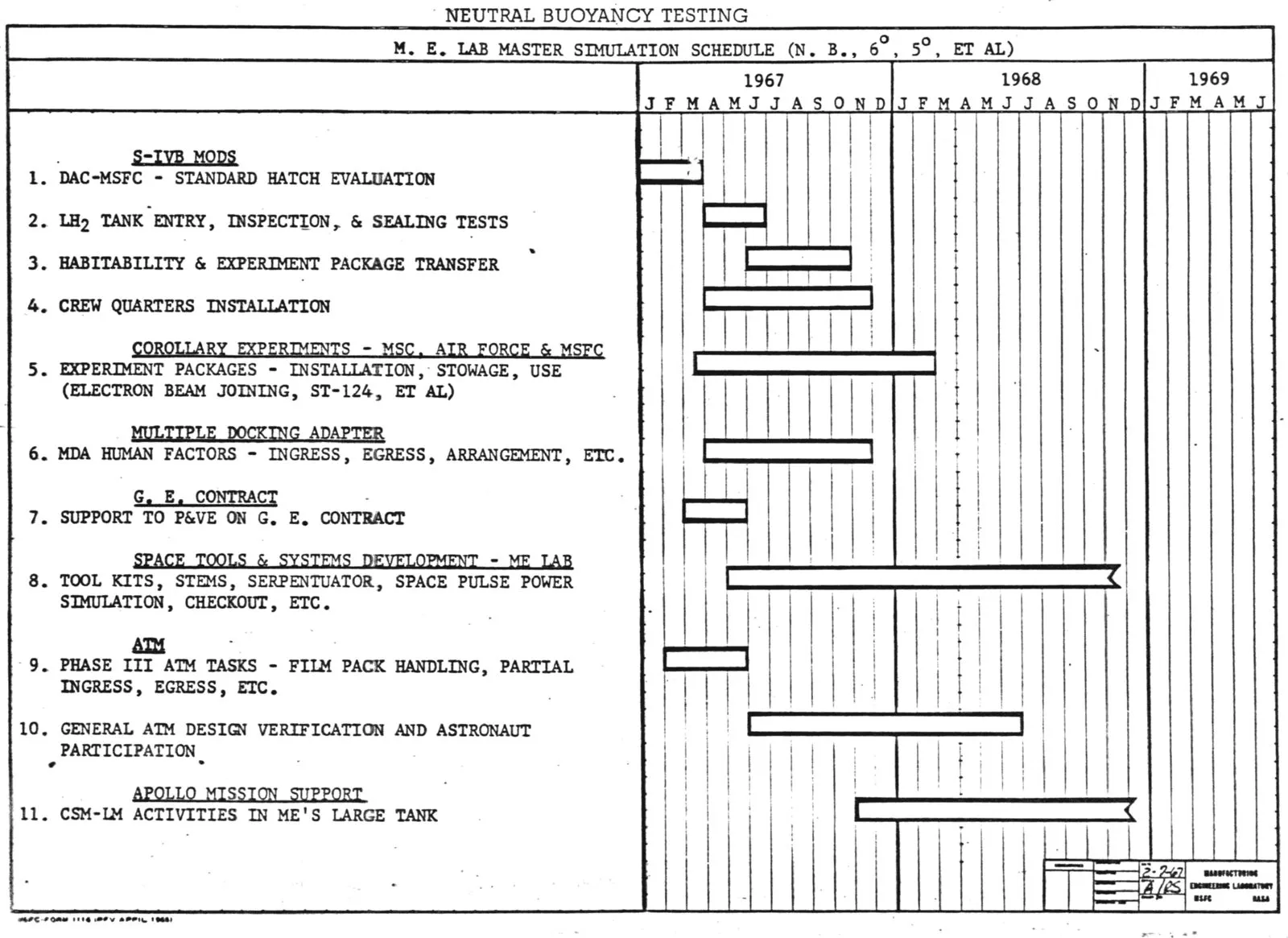
Scrum terms are quoted from the Scrum Guide (November 2020); exam facts come from the PMI PMP Examination Content Outline (July 2026), the PMI Certification Handbook (June 2026), the PMBOK Guide Eighth Edition table of contents and PeopleCert's PRINCE2 Version 7 exam pages (links above). Other definitions are our plain-English explanations. Last checked on 26 November 2026. The Scrum Guide is © 2020 Ken Schwaber and Jeff Sutherland and is offered under the Creative Commons Attribution Share-Alike licence (short quotations used here). PeakTalk is not affiliated with PMI, PeopleCert, AXELOS or Scrum.org. PMP and PMBOK are registered marks of PMI; PRINCE2 is a registered trademark of PeopleCert. Cover photo: Neutral Buoyancy Simulator Gantt chart March 1967 by NASA, public domain, via Wikimedia Commons.

Frequently asked questions
- What English does a project manager need?
- Mostly the language of status, scope, risk and people: on track, at risk, behind schedule; scope, deliverable, milestone, dependency; risk, issue, mitigation, escalation; sponsor, stakeholder, sign-off. Add meeting language (agenda, minutes, action items) and, in agile teams, the Scrum terms such as sprint, backlog and Definition of Done.
- What is the difference between a risk and an issue?
- A risk is something that may happen in the future and would affect the project. An issue is a problem that is happening now. You plan a mitigation for a risk; you resolve or escalate an issue.
- Is the PMP exam only in English?
- No. PMI's Certification Handbook (June 2026) says all PMI exams are available in English and some are translated into up to 15 languages; the PMP is one of them. During a translated exam you can also see each question in English using an on-screen button.
- How long is a Daily Scrum?
- The Scrum Guide calls the Daily Scrum "a 15-minute event for the Developers of the Scrum Team". Its purpose is to inspect progress toward the Sprint Goal and adapt the Sprint Backlog. The Developers choose its structure.
- What is scope creep?
- Scope creep is when the scope grows little by little without a formal decision — small changes are added without changing the time, budget or plan. The usual protection is a change request that is approved before the work starts.