
ATC phraseology vs plain English: the rule, the words, the differences
On the radio, pilots and controllers use two kinds of English. The first is standard phraseology: short, fixed phrases with one agreed meaning. The second is plain language: normal sentences for everything the phrases do not cover. You need both on the job, and a real flight can switch from one to the other in a second. The ICAO English test is mostly about the second kind: it checks how you explain things in normal English.
This guide explains the rule, the standard words that pilots most often get wrong, numbers, readback, what changes in an emergency, and the main differences between ICAO and US phraseology. Rules are quoted from ICAO, the UK CAA and the FAA.
The rule in one sentence
ICAO Annex 10, Volume II, paragraph 5.1.1.1:
"ICAO standardized phraseology shall be used in all situations for which it has been specified. Only when standardized phraseology cannot serve an intended transmission, plain language shall be used."
In short: use the standard phrase first, and use plain English only when no phrase fits. Three things follow from this:
- Phraseology comes first. ICAO Doc 9835 says that the need for plain language "should not be interpreted as suggesting that plain language can suffice instead of ICAO standardized phraseology. ICAO standardized phraseology should always be used in the first instance."
- The phrases do not cover everything. ICAO Doc 4444 says its phraseologies "are not intended to be exhaustive" (they do not list every possible message). When circumstances differ, pilots and controllers "will be expected to use plain language, which should be as clear and concise as possible".
- Plain language is not chat. Doc 9835 adds that the rule "should in no way be interpreted as permission to chat or otherwise ignore the formal and informal protocols that govern the use of standardized phraseology".
Phraseology and plain English side by side
| Situation | Standard phraseology | Plain English (no phrase exists) |
|---|---|---|
| You cannot follow an instruction because of a TCAS resolution advisory | "Unable, TCAS RA." | — |
| A passenger is ill | Urgency call: "Pan-pan, pan-pan, pan-pan…" | "…passenger ill, request return to Le Bourget." |
| You did not catch the instruction | "Say again." | — |
| The controller speaks too fast | "Speak slower." | "Your last message was too fast for me." |
| You need to explain a delay or negotiate a different route | Start with "Request…" | Describe the reason in short sentences |
Most phrases in the table come from the Confident ATC Communication course in PeakTalk. Note how plain English often follows a standard opening: the urgency signal or the word "request" comes first, then normal words explain the problem.
ICAO Doc 9835 gives examples of the unexpected, where "phraseology provides no ready-made form for communication": "an inexperienced pilot gets lost, a technical problem develops on the aircraft, a passenger falls sick, someone provokes a bomb alert, ATC equipment fails or the truly unexpected arises." It also says plain language "is a requirement in many everyday situations", not only in emergencies.
Standard words you must know
ICAO Annex 10 gives each standard word a fixed meaning. These are easy to confuse:
| Word | ICAO meaning | Watch out |
|---|---|---|
| ROGER | "I have received all of your last transmission." | Not "yes" and not a readback (see below). |
| AFFIRM | "Yes." | The FAA uses "affirmative". |
| NEGATIVE | "No" or "Permission not granted" or "That is not correct" or "Not capable". | |
| WILCO | "I understand your message and will comply with it." | By its meaning, wilco already says you received the message, so a "roger" in front of it adds nothing. |
| STANDBY | "Wait and I will call you." | "STANDBY is not an approval or denial." |
| UNABLE | "I cannot comply with your request, instruction, or clearance." | "UNABLE is normally followed by a reason." |
| SAY AGAIN | "Repeat all, or the following part, of your last transmission." | Be specific: "Say again all after descend." |
| CONFIRM | "I request verification of: (clearance, instruction, action, information)." | Use it when you are not sure, instead of guessing. |
| CORRECTION | "An error has been made in this transmission (or message indicated). The correct version is…" | |
| SPEAK SLOWER | "Reduce your rate of speech." | A standard request: you are allowed to use it. |
About ROGER, Annex 10 is very clear: it is "under no circumstances to be used in reply to a question requiring READ BACK or a direct answer in the affirmative (AFFIRM) or negative (NEGATIVE)". A typical mistake on a real frequency: the controller asks "Do you have the runway in sight?" and the pilot answers "Roger." The controller still does not know the answer. The correct reply is "Affirm" or "Negative".
Numbers: tree, fife, niner
Annex 10 says that when the radio language is English, numbers "shall be transmitted using the following pronunciation":
| Digit | Say | Digit | Say |
|---|---|---|---|
| 0 | ZE-RO | 5 | FIFE |
| 1 | WUN | 6 | SIX |
| 2 | TOO | 7 | SEV-en |
| 3 | TREE | 8 | AIT |
| 4 | FOW-er | 9 | NIN-er |
The basic rule: say each digit separately. Examples and exceptions from Annex 10:
- Heading 100 → "heading one zero zero". Runway 27 → "runway two seven". Flight level 180 → "flight level one eight zero".
- Exception: FL 200 → "flight level two hundred" (whole hundreds).
- QNH 1009 → "QNH one zero zero nine". Exception: QNH 1000 → "QNH one thousand".
- Frequency 118.1 → "one one eight decimal one". The decimal point is spoken as "decimal".
- Exception: altitudes in whole hundreds and thousands: 2,500 ft → "two thousand five hundred", 11,000 ft → "one one thousand" (examples from the UK CAP 413).
Readback: what you must always repeat
ICAO Doc 4444 (4.5.7.5.1) says the flight crew "shall read back" the safety-related parts of clearances and instructions. These items "shall always be read back":
- ATC route clearances;
- clearances and instructions to enter, land on, take off from, hold short of, cross, taxi and backtrack on any runway;
- runway-in-use, altimeter settings, SSR codes, level instructions, heading and speed instructions, and transition levels (from the controller or from ATIS).
The controller "shall listen to the readback" and correct any mistakes. Readbacks should include your call sign (SERA and CAP 413 say so explicitly). SERA (the UK version of Regulation 923/2012) also adds newly assigned frequencies to the list, and the UK list in CAP 413 is longer still.
Controller: "G-ABCD, descend to 3,000 feet, turn left heading 270." Pilot: "Descending to 3,000 feet, turning left heading 270, G-ABCD." Controller: "Readback correct."
If the readback is wrong, the controller says "negative" and gives the correct version.
The word "take-off" and Tenerife 1977
In the UK, CAP 413 makes the rule explicit: "The words 'TAKE-OFF' are used only when an aircraft is cleared for take-off (or if the take-off clearance is cancelled). At all other times the word 'DEPARTURE' is used." So: "after departure, turn right", never "after take-off, turn right".
The best-known case where an unclear "take-off" phrase was part of the problem is the collision of two Boeing 747s on the runway at Tenerife in 1977. The Spanish investigation named the fundamental cause: the KLM captain "took off without clearance" and did not stop when the Pan Am crew reported they were still on the runway. Language was listed separately as a factor that contributed:
"Inadequate language. When the KLM co-pilot repeated the ATC clearance, he ended with the words, 'we are now at take-off'. The controller, who had not been asked for take-off clearance, and who consequently had not granted it, did not understand that they were taking off."
The report also says that the tower's "O.K." was incorrect, but irrelevant in this case, because the take-off had already started about six and a half seconds before.
Emergencies: say the word
In 1990, Avianca Flight 052 ran out of fuel near New York. The NTSB found that the probable cause was "the failure of the flightcrew to adequately manage the airplane's fuel load, and their failure to communicate an emergency fuel situation to air traffic control before fuel exhaustion occurred". Among the contributing factors was "the lack of standardized understandable terminology for pilots and controllers for minimum and emergency fuel states".
The crew asked for "priority". According to testimony in the report, under FAA and ICAO rules the word "priority" had "no prescribed meaning in terms of required ATC controller action". The NTSB found that the first officer "never used the word 'Emergency'", and also that he "was sufficiently proficient in English to be understood". The crew did not use the standard words that make controllers act.
Today the standard emergency words are clear:
- MAYDAY for distress and PAN PAN for urgency, both "preferably spoken three times" (Annex 10).
- MINIMUM FUEL is not an emergency. Doc 4444 says it is "an indication that an emergency situation is possible should any additional delay occur".
- MAYDAY FUEL: Doc 4444 says these words "describe the nature of the distress condition". CAP 413 gives the call as "MAYDAY, MAYDAY, MAYDAY FUEL".
- In the US, the FAA AIM says a minimum fuel advisory "does not imply a need for traffic priority". If you need priority, "declare an emergency due to low fuel and report fuel remaining in minutes".
ICAO vs US phraseology
If you fly in the US or listen to US radio recordings, you will hear some differences:
| Topic | ICAO | US (FAA) |
|---|---|---|
| Waiting on the runway | "Line up and wait" | "Line up and wait" since 30 September 2010; before that, "position and hold" |
| Level change | "Climb to flight level two three zero" | "Climb and maintain flight level two three zero" (still current) |
| Pressure setting | "QNH one zero one three" (hectopascals) | "Altimeter three zero zero one" (inches of mercury) |
| Yes | "Affirm" | "Affirmative" |
| Readback | Listed items "shall always be read back" | Pilots "should read back the numbers"; "Wilco", "Roger" or "Affirmative" may be used for other information |
| Low fuel emergency | "MAYDAY FUEL" | "Declare an emergency due to low fuel" |
| Wait | "Standby" | "Stand by" (two words) |
The FAA changed "position and hold" to "line up and wait" to harmonise (make the same) with ICAO. In its notice, the FAA described the change as "harmonization between FAA and International Civil Aviation Organization (ICAO)" procedures.
What this means for the ICAO English test
ICAO requires Level 4 for both phraseology and plain language. But ICAO Doc 9835 says the language test itself should focus on plain language: "Teaching and testing standardized phraseology are operational issues, not a language proficiency issue." A test may use phraseology as a prompt, "but the test should not be designed to assess phraseology." One of the holistic descriptors says a proficient speaker can "handle successfully and with relative ease the linguistic challenges presented by a complication or unexpected turn of events". So in the test, expect tasks where no standard phrase fits and you must explain a problem in normal sentences. Phraseology itself is checked in your flight training.
For how the test works, the six criteria and a preparation plan, see our guide to ICAO English Level 4.
Common mistakes
- "Roger" as an answer to a question. Use "affirm" or "negative".
- "Roger" instead of a readback. Under ICAO and UK rules, runway, level, heading, speed, squawk and altimeter must be read back.
- "Take-off" outside the take-off clearance (UK rule). In UK radio, say "departure" until you are cleared for take-off.
- Vague words in an emergency. "Priority" or "we have a problem" is weaker than "Mayday" or "Pan-pan".
- Silence when you don't understand. Say "say again" or "confirm", or ask in plain English.
- Long plain-English explanations. Start with the key fact, then add details if the controller asks.
Try it: 5 quick questions
- The tower asks: "Do you have the runway in sight?" You see it. What do you say?
- a) "Affirm."
- b) "Roger."
- c) "Wilco."
- How do you say flight level 200?
- a) "Flight level two zero zero"
- b) "Flight level two hundred"
- c) "Flight level twenty"
- Under ICAO rules, which of these must always be read back?
- a) The weather at your destination
- b) A traffic advisory
- c) A heading instruction
- In a UK clearance, which phrase is correct before you are cleared for take-off?
- a) "After take-off, turn left"
- b) "After departure, turn left"
- c) "After take-off clearance, turn left"
- What does "standby" mean?
- a) Wait, I will call you back
- b) Request approved
- c) Request refused
Answers: 1 a · 2 b · 3 c · 4 b · 5 a
Practise ATC English in PeakTalk
Sources
- ICAO Annex 10, Volume II, 7th edition (copy published by the Swiss FOCA)
- ICAO Doc 4444, PANS-ATM, 16th edition (copy published by the Swiss FOCA)
- ICAO Doc 9835, Manual on the Implementation of ICAO Language Proficiency Requirements, 2nd edition
- ICAO language proficiency SARPs, Annex 1 Appendix 1 (Doc 9835 Appendix A, copy published by the Polish CAA)
- UK CAA — CAP 413 Radiotelephony Manual, Edition 24
- SERA, Regulation (EU) No 923/2012 (UK version)
- FAA — Pilot/Controller Glossary
- FAA — Order JO 7110.65, Chapter 2, Section 4 (radio and interphone communications)
- FAA — Aeronautical Information Manual, Chapter 5, Section 5
- FAA — Notice N JO 7110.536, Line Up and Wait (2010)
- Tenerife 1977 — conclusions of the Spanish investigation (ICAO Circular 153-AN/56, FAA copy)
- NTSB — Avianca Flight 052 accident report, AAR-91/04
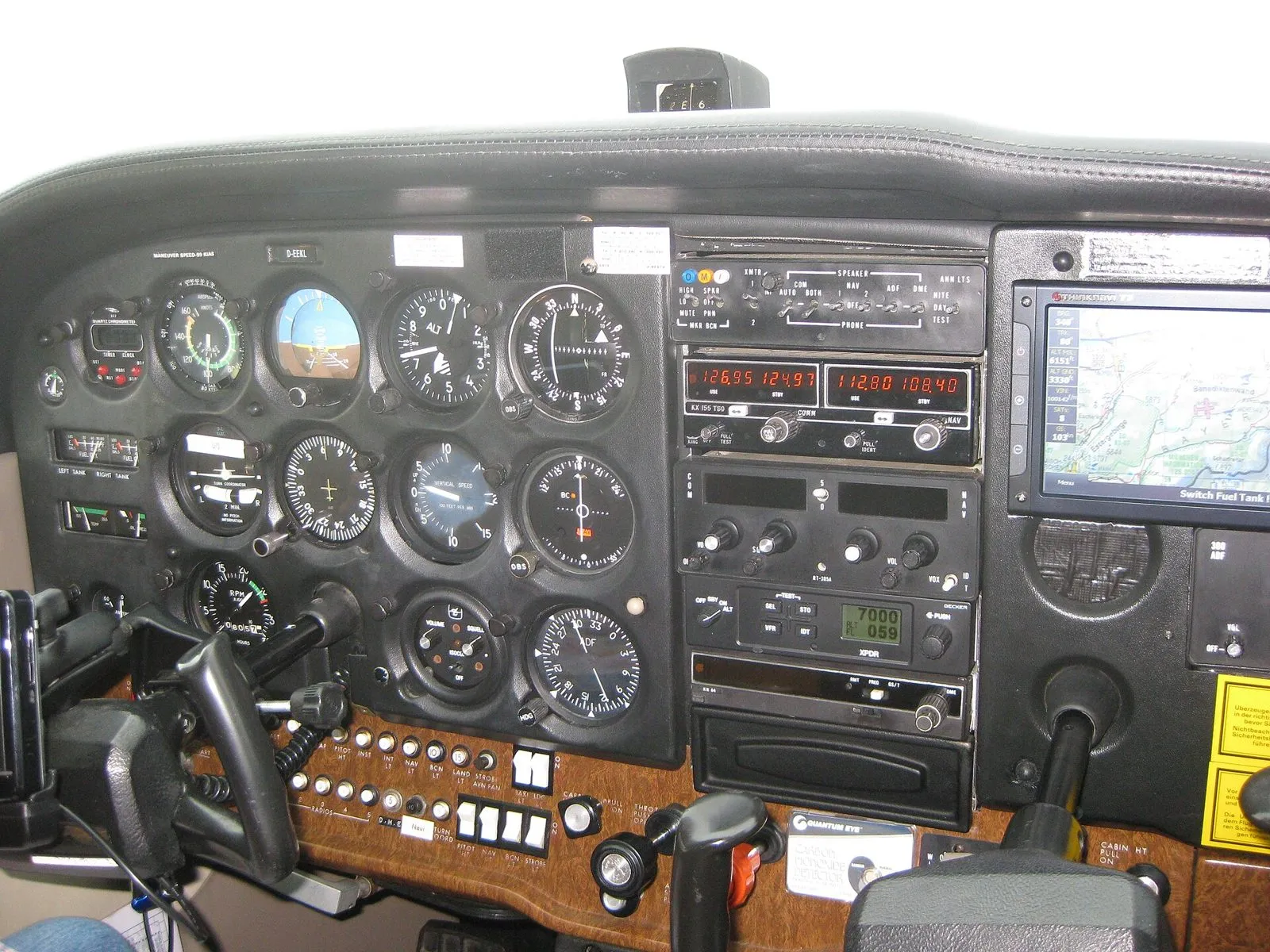
Rules in this guide are quoted from ICAO Annex 10 Volume II (7th edition) and Doc 4444 (16th edition) as published by the Swiss FOCA, ICAO Doc 9835, the UK CAA CAP 413 (Edition 24), SERA (UK version), and FAA publications (links above). Local rules can differ; follow your state's AIP and your operator. Last checked on 25 November 2026. Cover photo: Cessna 172 cockpit by Stefan, public domain, via Wikimedia Commons.

Frequently asked questions
- What is the difference between ATC phraseology and plain English?
- Phraseology is a fixed set of words and phrases with an agreed meaning, such as "line up and wait" or "unable". Plain language is normal, free speech. ICAO Doc 9835 defines it as "the spontaneous, creative and non-coded use of a given natural language". ICAO Annex 10 says standard phraseology shall be used in all situations for which it has been specified, and plain language only when phraseology cannot serve the message.
- When should a pilot use plain English on the radio?
- When no standard phrase fits: a sick passenger, a technical problem, a bomb alert, a lost pilot, an equipment failure, or a need to explain or negotiate. ICAO Doc 9835 notes that plain language is also needed in many everyday situations, not only in emergencies. It should still be clear and concise, and it does not replace phraseology where phraseology exists.
- Does "roger" mean yes?
- No. In ICAO phraseology, ROGER means "I have received all of your last transmission." ICAO Annex 10 says it is under no circumstances to be used in reply to a question that needs a read back or a direct yes or no answer. For yes, ICAO uses AFFIRM; for no, NEGATIVE.
- How do pilots say numbers on the radio?
- ICAO Annex 10 sets a pronunciation for numbers in English radio communication: ZE-RO, WUN, TOO, TREE, FOW-er, FIFE, SIX, SEV-en, AIT, NIN-er. Each digit is normally said separately (heading one zero zero), with exceptions for whole hundreds and thousands, for example flight level two hundred.
- Is US phraseology different from ICAO phraseology?
- In some places, yes. US controllers say "climb and maintain" where the ICAO form is "climb to", give "altimeter" settings in inches of mercury instead of QNH in hectopascals, and use "affirmative" where ICAO uses "affirm". The FAA adopted the ICAO phrase "line up and wait" in 2010, replacing "position and hold".