
English for truck drivers: the CDL English rule and how to prepare
If you drive a truck in the United States and English is not your first language, you have probably heard about the "English rule". Many drivers think it is new. It is not: the rule is decades old. What changed in 2025 is how strictly it is checked at the roadside, and what happens if a driver fails.
This guide explains the rule in simple words: what the federal regulation says, who it applies to, how an inspector checks your English, how it differs from the CDL test, and which English you actually need on the road. Everything is based on the regulation itself (49 CFR), the Executive Order of April 2025 and FMCSA's own documents in the Federal Register. At the end you will find real phrases from a truck driver English course and a short quiz.
The rule in one sentence
The rule is in the Federal Motor Carrier Safety Regulations, section 391.11(b)(2). A person is qualified to drive a commercial motor vehicle only if he or she:
"Can read and speak the English language sufficiently to converse with the general public, to understand highway traffic signs and signals in the English language, to respond to official inquiries, and to make entries on reports and records."
In short: you need enough English for four jobs — talking with people, reading signs, answering officials, and writing reports and logs. The rule does not name a test, a score or a level (like B1). It describes what you must be able to do.
The same section also speaks to the company: a motor carrier "shall not require or permit" an unqualified person to drive. So the carrier is responsible too.
Is it a new rule? A short timeline
No. FMCSA writes that the regulations "have required ELP since the 1930s" (ELP means English language proficiency). Here is what changed and when:
- December 23, 1936 — the Interstate Commerce Commission (ICC), which regulated interstate trucking before today's agencies, establishes the first English language requirement for drivers (it applied from July 1, 1937).
- April 1, 2005 — CVSA adds English violations to its out-of-service criteria. (CVSA, the Commercial Vehicle Safety Alliance, is a non-profit group of federal, state and local safety officials that writes the inspection standards.)
- April 1, 2015 — CVSA removes English from the out-of-service criteria.
- June 15, 2016 — FMCSA policy: inspectors cite English violations but do not place drivers out of service.
- April 28, 2025 — Executive Order 14286 tells FMCSA to cancel the 2016 policy, issue new inspection guidance, and work to change the out-of-service criteria so that an English violation puts the driver out of service.
- May 20, 2025 — new FMCSA policy memo on how to check English at the roadside.
- June 25, 2025 — CVSA's change takes effect: drivers who cannot meet the English requirement "will be declared out of service".
- April 16, 2026 — FMCSA memo on the US–Mexico border commercial zones (see below).
- August 10, 2026 — FMCSA proposes to write the out-of-service rule into the regulation itself. Comments closed on October 9, 2026. On the date this guide was checked, it was still a proposal, not a final rule.
The text of the rule did not change in 2025. The consequence did: since June 25, 2025, failing the English check can stop your trip. Note that the CVSA criteria are guidance for inspectors, not a federal regulation — that is why FMCSA now proposes to put the out-of-service rule into the regulation itself.
Who has to meet the English requirement
The rule applies to drivers of commercial motor vehicles (CMVs) in interstate commerce. Under 49 CFR 390.5, a CMV is, for example, a vehicle of 10,001 pounds or more, a vehicle designed or used to carry more than 8 passengers including the driver for pay, or more than 15 passengers including the driver when not paid, or a vehicle that carries hazardous materials in placarded amounts. Interstate commerce includes trips between states and trips that start or end outside the state or the country.
Some points drivers often ask about:
- Trips inside one state. States that receive federal safety money must have "compatible" rules, and FMCSA says this generally covers intrastate trips and includes section 391.11. Details depend on your state.
- Canadian and Mexican drivers. FMCSA writes that drivers from Canada and Mexico who drive in the US "have been subject to the ELP rules since they were implemented in the 1930s".
- US–Mexico border commercial zones. The rule itself has no exception. But under FMCSA's April 2026 policy, a driver is not placed out of service if the current trip stays inside a border commercial zone. The violation is still written.
- A few small exceptions in 49 CFR 391.2, such as some farm vehicle drivers and pipeline welding trucks.
How an inspector checks your English
FMCSA's August 2026 proposal describes the procedure from its May 2025 policy memo. The memo advises federal inspectors "to initiate all roadside inspections in English". State inspectors use the CVSA criteria, which include the same procedure. Then:
"If the inspector's initial contact with the driver indicates that the driver may not understand the inspector's instructions, the inspector should conduct an ELP assessment consisting of a driver interview (to determine a driver's ability to respond sufficiently to official inquiries) and, if the driver passes the interview step, a highway traffic sign recognition assessment (to determine a driver's ability to understand sufficiently United States highway traffic signs, including electronic-display changeable message signs in the English language)."
There are two steps:
- Interview. The inspector talks with you in English and checks that you can answer official questions.
- Sign recognition. If you pass the interview, you show that you understand US traffic signs, including electronic message boards.
The Federal Register documents used for this guide do not list the interview questions, and the public version of FMCSA's guidance is partly redacted. Be careful with websites that sell "the real ELP questions".
What "out of service" means. An out-of-service order is a declaration by an enforcement officer that a driver or vehicle may not continue. For the driver, the trip stops there. FMCSA notes that the carrier then "would need to find a replacement driver". FMCSA says it can also use other tools at its discretion, such as letters of disqualification and civil penalties.
The numbers. FMCSA's August 2026 proposal gives these figures: from January to June 24, 2025, there were 7,812 English violations, and 33 of them led to out-of-service orders. From June 25, 2025 to March 19, 2026, 19,045 English violations led to out-of-service orders. All of these out-of-service orders were outside the border commercial zones.
The CDL test and the roadside check are different
Many drivers say: "I passed my CDL test, so my English is fine." These are two different rules.
The CDL test rules are in 49 CFR 383.133:
- Knowledge test (written). It "can be administered in a foreign language, provided no interpreter is used". Which languages are offered is up to your state.
- Skills test (driving). "Applicants must be able to understand and respond to verbal commands and instructions in English by a skills test examiner." Interpreters are not allowed, and neither you nor the examiner may use another language during the test.
The roadside check under 391.11(b)(2) asks for more than following driving commands: you must answer questions, read signs and write reports. So a driver who took the written test in another language can still fail the roadside check.
FMCSA also says it "does not require that motor carriers train their drivers in the English language". In other words, preparing is up to you (or to your company, if it offers training).
The four English skills the rule names
Here is what each part of the rule looks like in a driver's day. The left column is the rule. The right column shows example situations: some come from official documents (marked), the rest are our own examples.
| The rule says | What it looks like on the road |
|---|---|
| Converse with the general public | Talk with dispatch, the shipper, the receiver, the gate guard (our examples). Executive Order 14286 says drivers need to "provide feedback to their employers and customers" in English |
| Understand highway traffic signs | Read warning signs, detours, weigh station signs and electronic message boards (the sign test, official) |
| Respond to official inquiries | Answer an inspector's questions at a roadside inspection (the interview, official). Executive Order 14286 also names officers at "traffic safety, border patrol, agricultural checkpoints, and cargo weight-limit station[s]" |
| Make entries on reports and records | Your vehicle inspection report and your record of duty status (records required by 49 CFR 396.11 and 395.8; FMCSA does not list them as English test items) |
Reports and records: what the rules say you write
Two records drivers often work with are the DVIR and the record of duty status:
- Driver vehicle inspection report (DVIR). 49 CFR 396.11 says "every driver shall prepare a report in writing at the completion of each day's work on each vehicle operated". The report must identify the vehicle, list any defect, and be signed by the driver. (If no defect is found, the rule does not require a report.) The parts listed in the rule include service brakes, parking brake, steering, lighting devices and reflectors, tires, horn, windshield wipers, rear-vision mirrors, coupling devices, wheels and rims, and emergency equipment.
- Record of duty status. 49 CFR 395.8 says carriers must require each driver to record his or her duty status for every 24 hours — usually in an ELD (electronic logging device). The duty statuses are off duty, sleeper berth, driving, and on duty not driving.
So "defect", "air leak", "tread", "on duty" and "sleeper berth" are not extra words. You use them every day.
Examples from PeakTalk courses
These sentences come from the English for Truck Driver course in PeakTalk. Read them out loud. Can you explain each one in your own words?
Inspection and defects
- "I always do a pre-trip inspection before I leave the yard."
- "During the post-trip inspection, I found a small air leak in the brake system."
- "This tire's tread is below the legal limit, so it needs to be replaced."
- "The ABS warning light stayed on, so I reported it to the dispatcher immediately."
- "The taillight is cracked, so we need to replace it before the truck goes back on the road."
Hours of service
- "I'm on duty while I wait to get loaded, even if I'm not driving."
- "I'm taking my required rest in the sleeper berth."
- "I'm pulling into the rest area to take my required break."
Signs and the road
- "The clearance sign on the overpass says 13 feet 6 inches, so make sure your truck fits under it."
- "Follow the detour signs because the main road is closed."
- "The breakdown happened near milepost 214 on the northbound side."
- "In an emergency, pull onto the shoulder and turn on your hazard lights."
Dispatch, gate and dock
- "Please provide your appointment number at the gate so we can check you in quickly."
- "If you arrive outside the appointment window, the receiver may refuse the load."
- "Dock door 7 is blocked, so the driver needs to wait until the area is clear."
- "At handover, please check the seal number and sign only if it matches the paperwork."
Common mistakes
- Saying "yes" to every question. If you do not understand, say so: "Sorry, could you say that again, slower?" Answering "yes" to a question you did not understand is worse than asking.
- Memorising answers. The interview is a conversation, and you cannot know the exact questions. Practise talking about your real trip: where you are coming from, where you are going, what you are hauling.
- Not knowing the words for your own truck. If you can't say "air leak", "tread" or "taillight", you can't write a DVIR or explain a defect.
- Mixing up duty statuses. Waiting at the dock when you are not relieved of duty is "on duty (not driving)", not "off duty". Know the four statuses in English.
- Reading numbers badly. Heights and weights on signs ("13 feet 6 inches", "80,000 lbs") and mileposts must be read correctly and fast.
How to prepare: concrete steps
- Read the rule (391.11(b)(2) above) and list the four skills. Mark the one that is hardest for you.
- Learn the words of your DVIR. Go through the parts listed in 396.11 and say each one out loud: service brakes, parking brake, steering, lights, reflectors, tires, horn, wipers, mirrors, coupling devices, wheels and rims, emergency equipment.
- Describe your trip in English. Practise five short sentences: who you drive for, where you loaded, where you are going, what you are hauling, when you started your shift.
- Read signs out loud. Read the signs you can see when you are parked, and say them in your head while you drive. Pay attention to electronic message boards.
- Practise asking for help. "Could you repeat that, please?" "Do you mean the bill of lading or the logbook?" Clear questions show that you understand.
Try it: 5 quick questions
- Which document contains the English rule for truck drivers?
- a) 49 CFR 383.133
- b) 49 CFR 391.11(b)(2)
- c) Executive Order 14224
- Since when can a driver be placed out of service for failing the English check under the CVSA criteria?
- a) June 25, 2025
- b) June 15, 2016
- c) April 1, 2015
- What is the second step of the roadside English check?
- a) A written grammar test
- b) A highway traffic sign recognition assessment
- c) A phone call with a language school
- Can the CDL skills test be done with an interpreter?
- a) Yes, in every state
- b) Yes, if the examiner agrees
- c) No, interpreters are not allowed
- A driver waits two hours at the dock. The driver must stay with the truck and be ready to work while it is loaded. What is the duty status?
- a) On duty (not driving)
- b) Off duty
- c) Sleeper berth
Answers: 1 b · 2 a · 3 b · 4 c · 5 a
Practise truck driver English in PeakTalk
Sources
- eCFR — 49 CFR 391.11, General qualifications of drivers
- eCFR — 49 CFR 383.133, Testing methods (CDL knowledge and skills tests)
- eCFR — 49 CFR Part 390 (applicability and definitions)
- eCFR — 49 CFR 396.11, Driver vehicle inspection reports
- eCFR — 49 CFR 395.8, Driver's record of duty status
- Federal Register — Executive Order 14286 of April 28, 2025
- Federal Register — FMCSA proposed rule, English Language Proficiency; Out-of-Service Criteria (August 10, 2026)
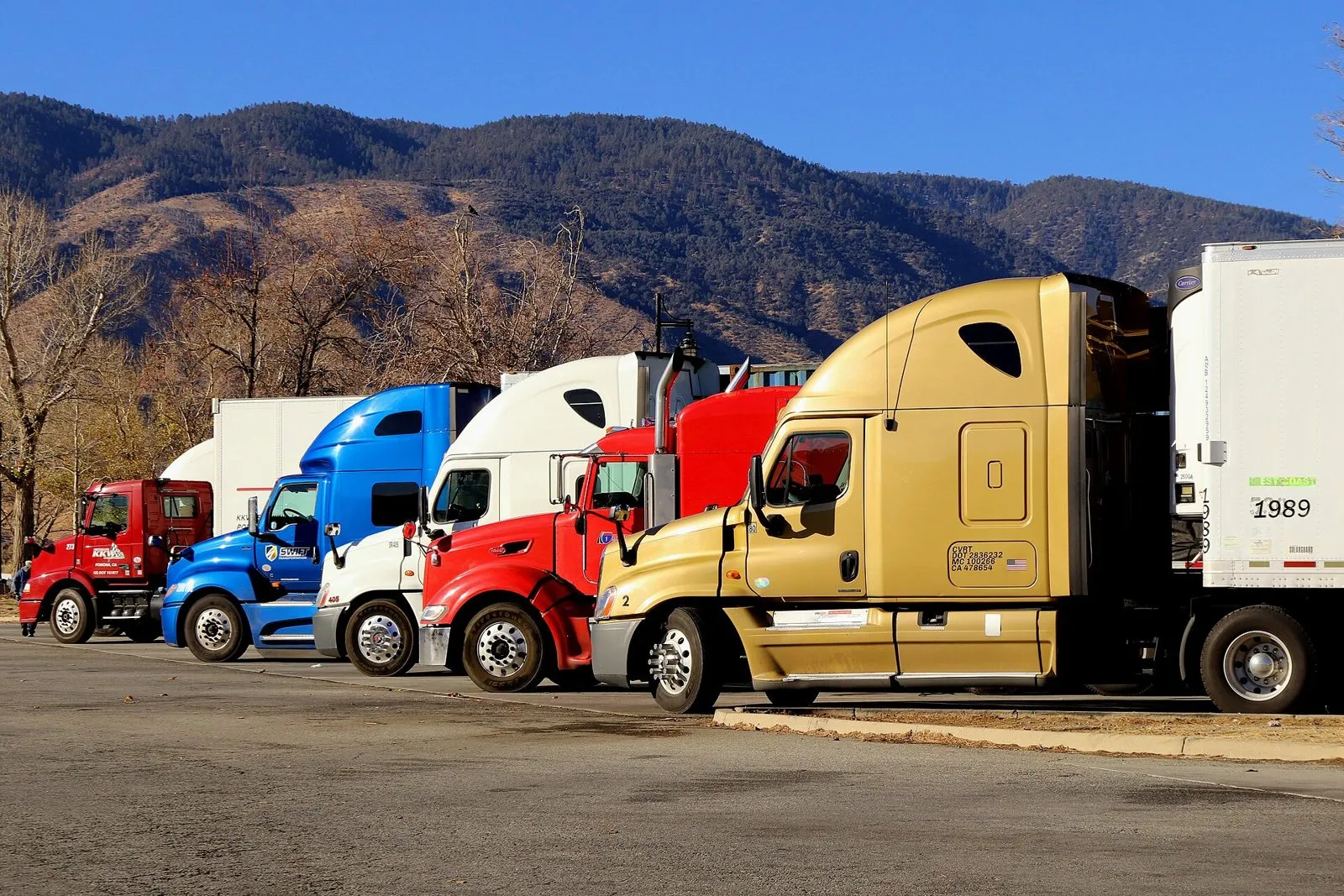
This guide quotes 49 CFR Parts 383, 390, 391, 395 and 396 (eCFR, current as of 24 November 2026), Executive Order 14286, and FMCSA's proposed rule of 10 August 2026 in the Federal Register (links above). It is not legal advice; rules and enforcement policy can change, so check FMCSA for the latest guidance. Last checked on 26 November 2026. PeakTalk is not affiliated with FMCSA, the US Department of Transportation or CVSA. Cover photo: “Colorful Semi-Trucks” (Lebec rest area, California) by Thank You (21 Millions+) views, CC BY 2.0, resized, via Wikimedia Commons.

Frequently asked questions
- Do CDL drivers have to speak English?
- Yes, in the US. Federal rule 49 CFR 391.11(b)(2) says a driver must be able to read and speak English well enough to talk with the public, understand traffic signs, answer officials' questions and fill in reports and records. It applies to commercial motor vehicle drivers in interstate commerce. States that receive federal safety funds must adopt compatible rules, and FMCSA says this generally covers trips inside the state too. Check your state's rules.
- Is the English requirement for truck drivers new?
- No. FMCSA says the rules have required English proficiency since the 1930s. What changed is enforcement: since June 25, 2025, a driver who fails the roadside English check is placed out of service under the CVSA out-of-service criteria. Between 2016 and 2025, federal inspectors only wrote a violation.
- How do inspectors test a truck driver's English?
- According to FMCSA's 2026 proposal, its May 2025 policy memo advises inspectors to start every roadside inspection in English. If the driver may not understand, the inspector does a short interview to see if the driver can answer official questions. If the driver passes the interview, the next step is a highway sign test, including electronic message signs. The proposed rule describes the steps but does not list the questions.
- Can I take the CDL test in another language?
- The written knowledge test can be given in a foreign language if the state offers it, but without an interpreter (49 CFR 383.133). The skills test is different: you must understand and answer the examiner's spoken instructions in English, and interpreters are not allowed. Which languages the written test is offered in depends on your state, so check with your state's licensing office.
- What happens if a truck driver fails the English check?
- The inspector writes a violation of 49 CFR 391.11(b)(2) and, outside the US-Mexico border commercial zones, places the driver out of service. The driver may not keep driving, and the carrier then needs to find a replacement driver. According to FMCSA, 19,045 English violations led to out-of-service orders between June 25, 2025 and March 19, 2026.